Quick answer
A good research question is focused, researchable with the data you can get, and analytical, usually starting with "how", "why" or "to what extent". Narrow a broad topic by adding a specific relationship, a context and a population, and check it against the FINER criteria used on many research methods courses. Health and nursing students often use PICO.
Learning how to write a research question is the first real step of any dissertation, thesis or research project. Your question decides what literature you read, which methods you use, what data you collect and what your conclusion can claim. A vague question leads to a vague dissertation. A sharp, well-scoped question makes almost every later chapter easier to write.
This guide explains what makes a good research question, how to narrow a broad topic down, the difference between qualitative and quantitative questions, how health and nursing students can use PICO, and how questions relate to aims and objectives. Along the way you will find research question examples from business, health and education, each shown as a weak version and an improved version, so you can see exactly what changes.
What is a research question?
A research question is the specific question your study sets out to answer. It is narrower than a topic and more precise than a title. 'Employee wellbeing' is a topic. 'How do hybrid working arrangements affect the perceived wellbeing of junior staff in UK accounting firms?' is a research question.
Most undergraduate and Master's dissertations have one main research question, sometimes supported by two to four sub-questions. PhD projects may have several. Your supervisor and your programme handbook are the best guide to how many your course expects.
Tip: A useful test: could you, in principle, write a one-paragraph answer to your question at the end of the project? If the honest answer is 'it depends on everything', the question is still too broad.
What makes a good research question? The FINER criteria
A widely used checklist, especially in health and clinical research, is FINER. In this guide we use the letters as Feasible, Interesting, Novel, Ethics and Relevant. Run your draft question through each one.
- Feasible: can you answer it with the time, word count, skills, budget and access to data or participants you actually have? A Master's dissertation over one summer cannot track customers for five years.
- Interesting: does it matter to you, your supervisor and your field? You will live with this question for months, so curiosity helps.
- Novel: does it add something, even something small, such as a new setting, population, time period or method? It does not need to be a world first, but it should not simply repeat a well-known study.
- Ethics: can it be answered in a way that would pass your university's research ethics review? Questions involving children, patients, vulnerable groups or sensitive data need extra care and approval before you collect anything.
- Relevant: does it connect to current debates in the literature, to practice or to policy? Markers look for a clear 'so what'.
Tip: Beyond FINER, a good research question is also clear (one reading, one meaning), focused (one main issue), researchable (answerable with evidence, not opinion) and arguable (not a simple yes or no fact you could look up).
How to narrow a topic into a research question
Almost every student starts with a topic that is too big. Narrowing it is a normal, step-by-step process.
- 1Start with a broad area you care about, for example 'social media marketing'.
- 2Do some background reading, especially recent review articles, to see what has already been studied and where authors say more research is needed. Phrases such as 'future research should' or 'little is known about' are useful clues.
- 3Narrow the population: who exactly? For example, small independent retailers, Generation Z consumers or first-year nursing students.
- 4Narrow the setting: where and when? A country, region, sector, organisation type or time period.
- 5Narrow the concept: which specific aspect? For example, influencer credibility rather than 'social media' in general.
- 6Choose the relationship or process you want to understand: an effect, a comparison, an experience, a factor or a process.
- 7Write the question, then test it against FINER and refine. Expect to go through several drafts and discuss them with your supervisor.
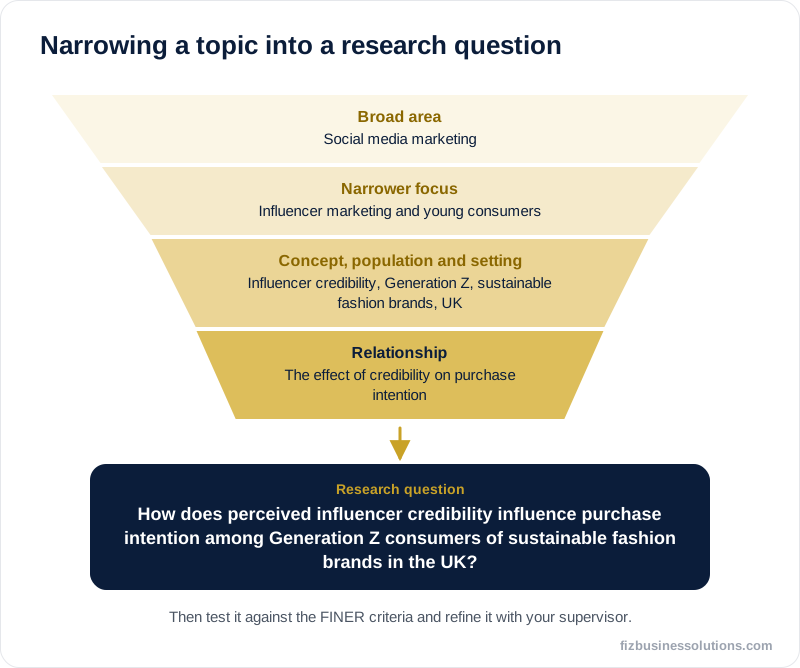
Tip: Worked example: 'Social media marketing' → 'Influencer marketing and young consumers' → 'How does perceived influencer credibility influence purchase intention among Generation Z consumers of sustainable fashion brands in the UK?'
Qualitative vs quantitative research questions
The way you phrase your question should fit your methodology. Qualitative and quantitative questions are worded differently because they aim to produce different kinds of knowledge.
Quantitative research questions
Quantitative questions ask about measurable variables: how much, how many, how often, whether there is a relationship or a difference. They usually lead to hypotheses and statistical tests, often run in software such as SPSS.
- Typical openings: 'What is the relationship between...', 'To what extent does X predict Y...', 'Is there a significant difference in...'
- Example: 'Is there a relationship between weekly hours of paid work and academic performance among final-year undergraduate students?'
Qualitative research questions
Qualitative questions explore experiences, meanings, perceptions and processes. They are open, usually begin with 'how' or 'what', and avoid assuming a cause and effect. Data often comes from interviews or focus groups and is analysed with approaches such as thematic analysis (Braun and Clarke, 2006).
- Typical openings: 'How do... experience...', 'What are the perceptions of...', 'How do... make sense of...'
- Example: 'How do newly qualified nurses experience the transition from student to registered practitioner on acute medical wards?'
Mixed methods questions
Mixed methods studies combine both, often with one quantitative and one qualitative sub-question, plus a question about how the two sets of findings relate. Only choose mixed methods if you have the time and word count to do both parts well.
Using PICO for health and nursing research questions
In nursing, midwifery, medicine and allied health, students are often asked to build their question using PICO, particularly for systematic or structured literature reviews. PICO breaks a clinical question into four parts, which also become your search terms.
- P: Population or Patient problem. Who are you studying? For example, adults with type 2 diabetes.
- I: Intervention or exposure. What is being done or experienced? For example, a nurse-led education programme.
- C: Comparison. What is it compared with? For example, standard care. Not every question has one.
- O: Outcome. What result are you interested in? For example, blood glucose control or self-management confidence.
PICO example
'In adults with type 2 diabetes (P), does a nurse-led education programme (I), compared with standard care (C), improve glycaemic control (O)?'
Variations include PICOT (adding Time frame) and, for qualitative evidence, PEO (Population, Exposure, Outcome) or SPIDER. Check which framework your module recommends.
Research question examples: weak vs strong
The quickest way to learn how to write a research question is to compare drafts. In each pair below, notice how the strong version specifies who, where, what and how it will be studied.
Business and management
- Weak: 'Is leadership important for employees?' (Too broad, yes or no, no setting.)
- Strong: 'How do employees in UK small and medium-sized enterprises perceive the influence of transformational leadership on their job satisfaction?'
- Weak: 'What is the impact of COVID-19 on business?' (Huge scope, no clear variable.)
- Strong: 'How did independent restaurants in Manchester adapt their revenue models between 2020 and 2022, and which adaptations have they retained?'
Health and nursing
- Weak: 'How can we reduce stress in nurses?' (Vague population, implies a solution without evidence.)
- Strong: 'What coping strategies do intensive care nurses in NHS hospitals report using to manage work-related stress?'
- Weak: 'Does exercise help older people?' (Which exercise, which people, which outcome?)
- Strong: 'In community-dwelling adults aged 65 and over, is a supervised strength and balance programme, compared with usual activity, associated with fewer falls?'
Education
- Weak: 'Is online learning good?' (Value judgement, no defined outcome.)
- Strong: 'How do first-year undergraduate students at a UK university perceive the effectiveness of recorded lectures compared with live seminars for understanding course content?'
- Weak: 'Why do students not read?' (Assumes a problem, too general.)
- Strong: 'What factors do Year 9 teachers in English secondary schools identify as barriers to independent reading for pleasure?'
Tip: Saunders, Lewis and Thornhill's Research Methods for Business Students is a helpful source for business and management students who want more detail on turning a topic into research questions and objectives.
Research aims vs objectives vs research questions
These three terms are often confused, but most UK dissertation proposals expect all three, and they must line up with each other.
- Aim: one broad statement of what the study intends to achieve. Example: 'To explore how hybrid working affects the wellbeing of junior staff in UK accounting firms.'
- Objectives: three to five specific, achievable steps that will deliver the aim. They usually begin with action verbs such as identify, examine, compare, evaluate or recommend. Example: 'To identify the main wellbeing challenges reported by junior staff working hybrid patterns.'
- Research questions: the questions your data and analysis will answer. Each objective often maps onto a question. Example: 'What wellbeing challenges do junior staff working hybrid patterns report?'
Tip: Put your aim, objectives and questions in a simple table side by side. If an objective has no matching question, or a question is not covered by your methods, fix it now rather than in the final chapter.
Common mistakes when writing a research question
- Making it too broad, for example covering a whole industry, country or global trend in a 10,000 word dissertation.
- Making it too narrow or trivial, so the answer is a single fact you could find online.
- Writing a yes or no question with no room for analysis.
- Building in assumptions, such as 'Why is social media damaging to students?', which presumes the answer.
- Using vague terms like 'effective', 'impact' or 'success' without saying how they will be defined or measured.
- Choosing a question you cannot get data for, for example needing interviews with senior executives you have no access to.
- Mismatching the question and the method, such as asking 'to what extent' and then interviewing five people, or asking about lived experience and running a survey of closed questions.
- Letting the question drift during the project without updating the introduction, aims and conclusion to match.
Need help with your dissertation research question?
If you are struggling to narrow your topic or your supervisor has asked you to refine your question, FIZBS can help. Our experts hold Master's and PhD qualifications and can give guidance on research questions, aims and objectives, proposals and methodology across business, health, education and many other subjects.
Dissertation support is priced at £30 per 1,000 words. You can message us on WhatsApp 24/7 or book a call with an expert before you order, and everything is 100% confidential.