Quick answer
A research proposal explains what you want to study, why it matters and how you will do it. Most include a title, background, research problem, aim, objectives and research questions, a short literature review, methodology, research approval and consent, a timeline and references. Master's proposals are often 1,000 to 3,000 words, and PhD proposals are commonly longer.
A research proposal is the plan for your study. It shows your supervisor, an admissions panel or a funder what you want to investigate, why the question is worth answering and how you will answer it in the time you have. For a Master's dissertation it is usually the document that gets your topic approved. For a PhD it can decide whether you are offered a place, a supervisor and sometimes funding.
The good news is that almost every proposal follows the same logic: a clear problem, focused questions, evidence that you know the literature, and a realistic method. If each section answers one question in that chain, the proposal reads as a convincing plan rather than a list of ideas.
This guide walks you through each section, explains how Master's and PhD proposals differ, and ends with a short illustrative example and a checklist you can use before you submit.
What a research proposal is for
Readers of a proposal want answers to three questions. Is this question worth researching? Can it realistically be answered with the time, data and skills available? And is this student able to carry it out? Every part of your proposal should help answer at least one of them.
That is why a proposal is persuasive writing as well as planning. You are not only describing what you will do; you are justifying each choice so that the reader is confident the project will succeed.
How long should a research proposal be?
Length depends on your university and level. Many undergraduate and Master's dissertation proposals are between 1,000 and 3,000 words. PhD proposals are commonly 1,500 to 3,000 words or more, and some universities set their own limits for admission. Always follow the word limit and template in your handbook or on the application page, because going over it can count against you.
Research proposal structure: section by section
Headings vary slightly between universities, but most proposals include the following sections in this order.
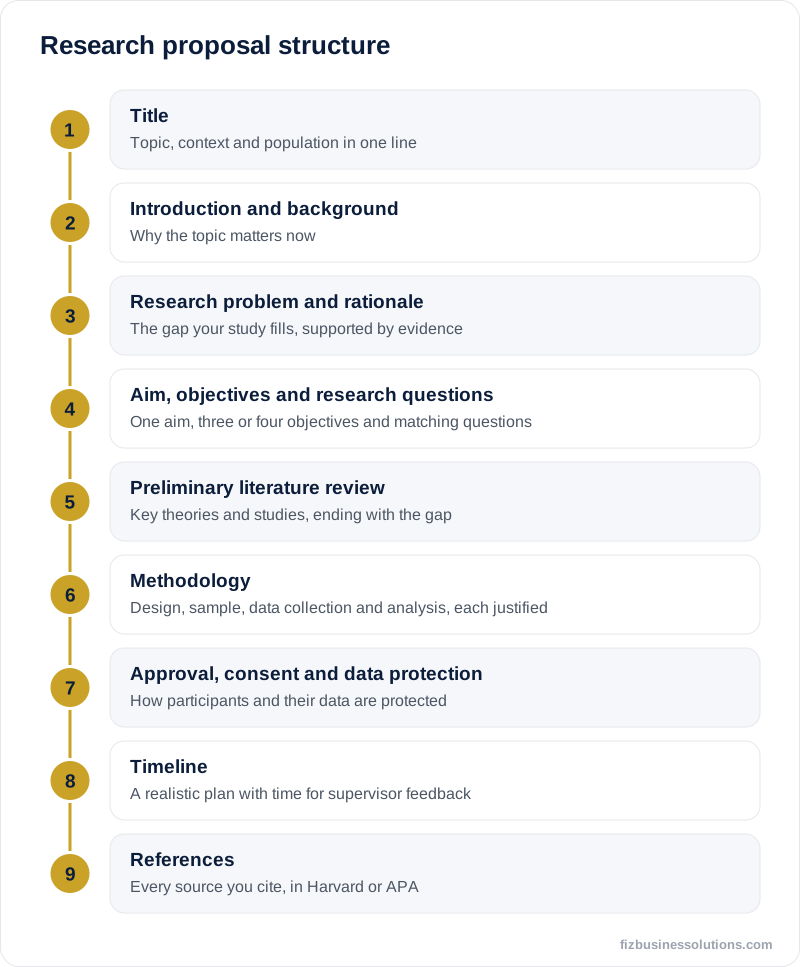
1. Title
A working title that names the topic, the context and, where relevant, the population or method. It can change later, but it should already tell the reader exactly what the study is about.
2. Introduction and background
Set the scene in a few paragraphs: the wider topic, why it matters now, and the specific setting of your study. Use recent sources and, where possible, a statistic or report that shows the issue is real.
3. Research problem and rationale
State the gap or problem your study addresses. Good rationales point to something specific: a context that has not been studied, mixed findings that need explaining, or a recommendation for further research in recent studies. Then say who would benefit from the answer.
4. Aim, objectives and research questions
One overall aim, three or four objectives that break the aim into steps, and research questions that match the objectives. Quantitative studies may also state hypotheses.
5. Preliminary literature review
A short, critical review of the key theories and studies. Organise it by theme, compare authors rather than summarising them one by one, and finish by showing where your study fits.
6. Methodology
Explain and justify your research design, sample, data collection and data analysis. Show that the method can actually answer your questions and that you can access the data.
7. Research approval, consent and data protection
Explain how you will gain approval from your university's research committee, obtain informed consent, keep participants anonymous and store data securely.
8. Timeline
A simple plan, often a table or Gantt chart, showing when you will complete the literature review, data collection, analysis and writing. Build in time for supervisor feedback and delays.
9. References
Every source you cite, in the referencing style your department uses, usually Harvard or APA.
Tip: Write the problem statement and research questions first, even if they appear later in the document. Every other section should support them.
Writing aims, objectives and research questions that match
Markers quickly notice when the aim, objectives and questions do not line up. A simple test is that each objective should lead to one research question, and answering all the questions should achieve the aim.
- Aim: To examine how perceived influencer credibility affects purchase intention among Generation Z consumers of sustainable fashion brands in the UK.
- Objective 1: To review research on influencer credibility and purchase intention.
- Objective 2: To measure the relationship between perceived credibility and purchase intention in this group.
- Objective 3: To recommend how sustainable fashion brands can select and brief influencers.
- Matching question: To what extent does perceived influencer credibility predict purchase intention among UK Generation Z consumers of sustainable fashion?
The literature review section of a proposal
In a proposal, the literature review is short and has one job: to show that you know the main debates and that there is a gap your study can fill. Focus on the most relevant theories and the most recent, high-quality studies. Group them by theme, point out where findings agree or disagree, and end with a sentence that states the gap clearly, for example: 'Few studies have examined this relationship among Generation Z consumers in the UK sustainable fashion market.'
Methodology: show that your plan is realistic
The methodology section is where many proposals are won or lost. Reviewers want to see that you have thought through the practical details and can justify each choice.
- Design: quantitative, qualitative or mixed methods, and why it fits your question
- Sample: who you will study, how many, how you will recruit them and why that is enough
- Data collection: questionnaires, interviews, focus groups, documents or secondary data
- Data analysis: for example regression in SPSS, or thematic analysis of interview transcripts
- Limitations: what your design cannot tell you, and how you will reduce the main risks
How Master's and PhD proposals differ
- Purpose: a Master's proposal agrees a project with your supervisor; a PhD proposal often decides admission, supervision and funding
- Originality: a Master's proposal needs a clear rationale; a PhD proposal must show a genuine contribution to knowledge
- Depth: a PhD proposal needs a deeper command of the literature and a more detailed, defensible methodology
- Timeline: a Master's project covers a few months; a PhD covers three to four years
- Fit: PhD applicants should also show why the project suits the department and the potential supervisor
A short research proposal example (outline)
The outline below is an illustrative example for a Master's marketing dissertation. It shows how the sections connect; your own proposal will need full paragraphs and real sources.
- 1Title: Influencer credibility and purchase intention among Generation Z consumers of sustainable fashion in the UK.
- 2Background: growth of influencer marketing and of sustainable fashion, and concern about greenwashing.
- 3Problem: studies of influencer credibility rarely focus on sustainable products or on Generation Z in the UK.
- 4Aim and questions: as in the example above, with one main question and two sub-questions.
- 5Literature: source credibility theory, parasocial relationships and research on green purchase intention.
- 6Method: online questionnaire using established scales, about 200 respondents aged 18 to 27, analysed with correlation and regression in SPSS.
- 7Approval and consent: university research approval, anonymous responses and secure data storage.
- 8Timeline: literature review in month 1, data collection in month 2, analysis in month 3, writing up in month 4.
Common research proposal mistakes
- A topic that is too broad to answer in the time available
- A problem statement with no evidence that the problem exists
- Aims, objectives and questions that do not match each other
- A literature review that summarises sources one by one instead of comparing them
- A method that cannot answer the question, or data you cannot actually access
- No timeline, or a timeline with no room for delays
- Ignoring the word limit or the template your university provides
Research proposal checklist
- The title names the topic, context and population
- The problem is supported by evidence and recent sources
- There is one aim, three or four objectives and matching questions
- The literature review ends by stating a clear gap
- Every methodological choice is justified
- Approval, consent and data protection are covered
- The timeline is realistic and includes time for feedback
- References are complete and in the required style
Reference your sources in seconds
Paste a DOI, ISBN or web link into our free Harvard referencing generator and get the full reference and in-text citation, ready to copy into your work. Using APA 7? Try the free APA referencing generator.