Quick answer
To write a literature review, search academic databases with a clear keyword strategy, screen sources for relevance and quality, and organise them by theme in a synthesis matrix. Then write critically: compare and evaluate studies rather than summarising them one by one, and finish by stating the research gap your study addresses.
Knowing how to write a literature review is one of the most important skills in a dissertation, thesis or research proposal. A literature review is not a list of summaries. It is a critical, organised discussion of what is already known about your topic, where researchers agree and disagree, and what is still missing. That missing piece, the research gap, is what justifies your own study.
This guide walks you through the full process: searching databases, choosing keywords, screening sources, organising your reading in a synthesis matrix, choosing a structure, writing critically and identifying the gap. The same approach works for undergraduate dissertations, Master's projects and standalone literature review assignments.
What is a literature review and what is it for?
A literature review surveys published research on a defined topic and evaluates it. In a dissertation, it usually sits after the introduction and before the methodology chapter, and it does several jobs at once.
- Shows your marker that you understand the key theories, debates and studies in your field.
- Explains the concepts and theoretical framework your own research will use.
- Compares and evaluates previous studies rather than simply describing them.
- Identifies a gap, weakness or unresolved question in the existing research.
- Justifies your research questions and, often, your choice of methods.
Tip: Before you start, write your research question or aim on a sticky note. Every source you include should help answer the question: what does this tell me about my topic?
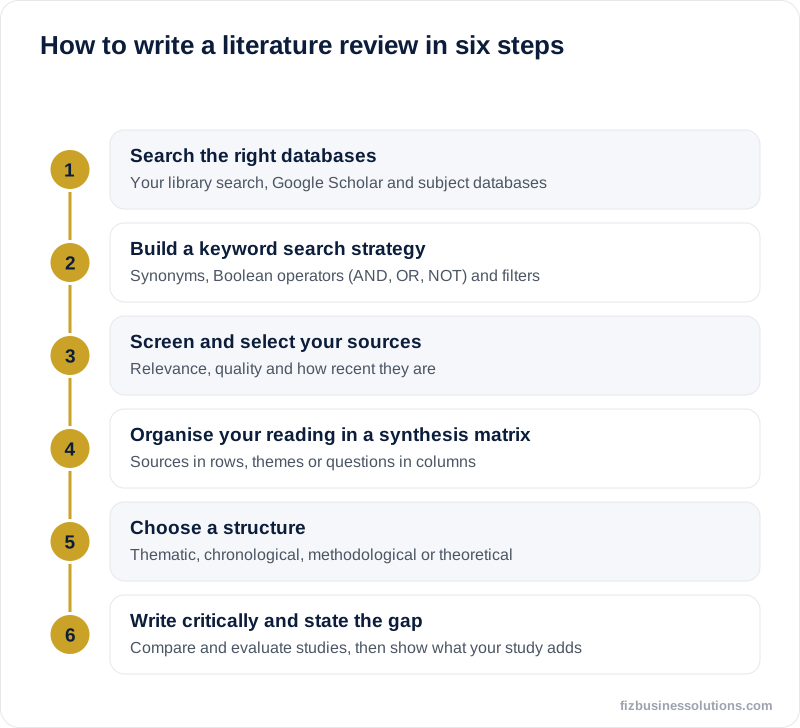
Step 1: Search the right databases
Google Scholar is a useful starting point, but it should not be your only source. Your university library gives you access to subject databases that return more relevant, peer-reviewed results and let you filter by date, document type and subject.
- Multidisciplinary: Scopus, Web of Science, JSTOR, ProQuest and your library's own search tool.
- Business and management: Business Source Complete (EBSCO), Emerald Insight and ProQuest's business collections.
- Health and nursing: PubMed/MEDLINE, CINAHL and the Cochrane Library.
- Psychology and education: PsycINFO and ERIC.
- Grey literature: government reports, industry bodies and theses, which can be useful context, though they are usually not peer reviewed.
Tip: Use the 'cited by' link in Google Scholar and the reference list of a strong recent article to trace key studies backwards and forwards. This is often faster than keyword searching alone.
Step 2: Build a keyword search strategy
Break your research question into two or three main concepts, then list synonyms and related terms for each one. Combine them using Boolean operators. For example, a study on remote work and employee wellbeing might use the concepts 'remote work', 'wellbeing' and 'employees'.
- AND narrows your search: "remote work" AND wellbeing.
- OR broadens it with synonyms: ("remote work" OR teleworking OR "working from home").
- NOT excludes terms, but use it carefully as it can remove relevant papers.
- Quotation marks search for an exact phrase: "employee engagement".
- An asterisk truncates a word in most databases: employ* finds employee, employees, employer and employment.
- Keep a simple search log (database, date, search string, number of results). It makes your methodology easier to write and lets you repeat searches later.
Step 3: Screen and select your sources
Your searches will usually return far more results than you can read. Screening helps you narrow them down in a consistent, defensible way. Decide your inclusion and exclusion criteria before you start, for example publication date range, language, peer-reviewed status, geographical context or population studied.
- 1Remove duplicates found across different databases.
- 2Screen titles and abstracts against your criteria and remove clearly irrelevant papers.
- 3Read the full text of the remaining papers and decide which to include, noting a brief reason for each exclusion.
- 4Check the quality of each included study: is the method appropriate, the sample adequate and the conclusion supported by the data?
- 5Add key papers found by following reference lists and citations.
Tip: If you are writing a systematic review, your university will probably expect a PRISMA flow diagram showing how many records were identified, screened, excluded and included. For a standard dissertation review, a short paragraph explaining your search and criteria is usually enough.
Step 4: Organise your reading with a synthesis matrix
A synthesis matrix is a table that helps you see connections between sources. Instead of making separate notes on each paper, you record each source in a row and the main themes or variables in columns. Patterns, agreements and contradictions then become visible, which is exactly what you need to write critically.
A simple matrix might use these columns:
- Author and year
- Aim or research question
- Context and sample (country, sector, participants)
- Method (survey, interviews, experiment, case study, review)
- Key findings
- Theme 1, Theme 2, Theme 3 (what the source says about each)
- Strengths and limitations
- Relevance to your study
Tip: You can build a synthesis matrix in Excel, Google Sheets or a table in Word. Reference managers such as Zotero or Mendeley are useful alongside it for storing PDFs and generating citations.
Step 5: Choose a literature review structure
Like any academic chapter, a literature review has an introduction, a main body and a conclusion. The introduction states the scope and how the chapter is organised. The conclusion summarises the key points and states the gap. The real choice is how to organise the main body.
Thematic structure
The body is divided into themes or debates, each with its own subheading. This is the most common and usually the most effective structure because it pushes you to compare sources. For example, a review on remote work might use sections on productivity, wellbeing and isolation, and management and trust.
Chronological structure
Sources are discussed in the order the field developed, showing how thinking has changed over time. This works when there are clear turning points, such as a new policy or technology. Avoid turning it into a timeline of summaries: explain why ideas changed and what that means.
Methodological structure
Studies are grouped by research approach, for example quantitative surveys, qualitative interviews and mixed methods. This is useful when different methods have produced different findings, or when you need to justify your own choice of method.
Theoretical structure
Sections are organised around competing theories or models, often leading to the framework you will adopt. Many reviews combine approaches, such as a thematic body with a short theoretical section at the start.
Step 6: Write critically, not descriptively
The most common feedback on literature reviews is 'too descriptive'. Critical writing means comparing sources, evaluating their quality and explaining what they mean for your topic. A useful rule is that each paragraph should be built around a point you are making, not around a single author.
A descriptive sentence: Smith (2020) studied remote workers and found higher productivity. A critical version: While Smith (2020) reports higher productivity among remote workers, the study relied on self-reported data from a single technology firm, which limits how far the findings can be applied to other sectors.
Example sentences for comparing sources
- Several studies agree that... (Author, Year; Author, Year).
- This finding is consistent with / contradicts the work of...
- In contrast to earlier research, more recent studies suggest...
- Although both studies examine..., they reach different conclusions because...
Example sentences for evaluating sources
- However, the small sample size limits the generalisability of these findings.
- A strength of this study is its longitudinal design, which allows...
- This conclusion should be treated with caution, as the data were collected...
- The model has been criticised for overlooking...
Example sentences for synthesising and linking to your study
- Taken together, these studies suggest that...
- Overall, the evidence points to..., although questions remain about...
- This debate is particularly relevant to the present study because...
Step 7: Identify and state the research gap
The research gap is the link between your literature review and your own study. It shows what existing research has not yet answered and why your project is worth doing. Gaps usually emerge from your synthesis matrix when you notice what is missing or inconsistent.
- Contextual gap: the topic is well studied in one country, sector or population but not another.
- Methodological gap: most studies use one method, such as surveys, so an in-depth qualitative study could add something new.
- Theoretical gap: a theory has not been applied or tested in a particular setting.
- Conflicting evidence: studies disagree and the reasons are unclear.
- Time gap: the evidence is dated and conditions have changed, for example after new regulations or technology.
Tip: Example: 'While existing research has examined remote work and wellbeing in large technology firms, little attention has been given to small and medium-sized enterprises. This study addresses that gap by...' Be specific, and avoid claiming that 'no research exists' unless your searches genuinely support that.
Common literature review mistakes to avoid
If you are struggling to move from summary to synthesis, the FIZBS literature review team can review a draft and show you where to strengthen comparison and critical analysis.
- Writing one paragraph per source, which produces a list of summaries rather than an argument.
- Including sources that are not relevant to your research question just to increase the count.
- Relying heavily on old or non-academic sources when recent peer-reviewed work is available.
- Describing findings without evaluating the methods or limitations behind them.
- Using too many long quotations instead of paraphrasing and analysing.
- Forgetting to explain how the reviewed literature connects to your own study.
- Leaving the research gap vague or failing to state it clearly at the end of the chapter.
- Inconsistent or incomplete referencing, especially when combining notes from many sources.
Need help with your literature review?
A good literature review takes time: searching, reading, organising and rewriting until the argument is clear. If you need expert guidance, FIZBS has supported students since 2015 with dissertations and research projects across more than 115 subjects, especially business, management and MBA topics. Our experts hold Master's and PhD qualifications and can help with search strategies, structure, critical writing and referencing.
Dissertation support is priced at £30 per 1,000 words. You can message us on WhatsApp 24/7 or book a call with an expert before ordering to discuss your topic.
Reference your sources in seconds
Paste a DOI, ISBN or web link into our free Harvard referencing generator and get the full reference and in-text citation, ready to copy into your work. Using APA 7? Try the free APA referencing generator.