Quick answer
To write a dissertation, choose a focused topic you can research, write a proposal, plan a realistic timeline, then draft the chapters: introduction (about 10%), literature review (20 to 30%), methodology (10 to 15%), findings (15 to 20%), discussion (20 to 25%) and conclusion (5 to 10%). Meet your supervisor regularly and leave time to edit and proofread.
Knowing how to write a dissertation is not something most students are taught directly. You may have written dozens of essays, but a dissertation is a different kind of project: longer, more independent, and built around a research question that you choose and answer yourself. For many UK undergraduates it is 8,000 to 12,000 words; for Master's students it is often 12,000 to 20,000 words. Either way, it usually carries a large share of your final classification.
This guide walks you through the whole process in the order you will actually face it: choosing a topic, writing a proposal, planning a timeline, structuring each chapter (with typical word count shares), working with your supervisor, writing up, editing, and the mistakes that cost students marks most often. Use it alongside your module handbook, because many UK universities have their own rules on structure, word limits and formatting.
What makes a dissertation different from an essay
An essay usually answers a question someone else has set, using existing sources. A dissertation asks you to identify a gap or problem, design a way to investigate it, and present findings that are your own. Markers are looking for independent thinking, a clear research question, a justified method, and a conclusion that follows logically from your evidence.
That means the skills that matter most are planning and consistency. A dissertation where the research question, method, findings and conclusion all line up will usually score better than one with beautiful writing but a loose thread running through it.
- Empirical dissertations collect primary data (surveys, interviews, experiments, observations).
- Secondary or desk-based dissertations analyse existing data, documents or published studies.
- Literature-based dissertations, common in some humanities and health courses, build an argument from a structured review of published work.
Step 1: Choose a dissertation topic you can actually research
A good topic sits where three things overlap: it interests you, it is relevant to your course, and it is researchable within your time, word count and access to data. Students often pick something too broad ('the impact of social media on business') and then struggle to say anything specific.
- 1List three or four areas from your modules that genuinely interest you.
- 2Read recent journal articles in each area and note what authors say needs further research (often in their conclusion or limitations sections).
- 3Narrow by context: a specific industry, country, organisation type, population or time period.
- 4Turn the topic into one clear research question, plus two to four objectives.
- 5Check feasibility: can you get the data, participants or sources you need in the time available?
Tip: Example of narrowing: 'Social media and business' becomes 'How do small UK fashion retailers use Instagram to build customer loyalty?' The second version tells you who to study, what to measure and where to look.
Step 2: Write a clear dissertation proposal
Most UK universities ask for a proposal before you start, sometimes assessed and sometimes just for approval. Even when it is not graded, a strong proposal saves weeks later because it forces you to make decisions early.
A typical proposal is 1,000 to 3,000 words and includes the following elements. Check your handbook for the exact format required.
- Working title and research question.
- Aims and objectives (specific, measurable where possible).
- Background and rationale: why this matters and what gap it addresses.
- Brief literature overview with key authors and debates.
- Proposed methodology: approach, data collection, sample, analysis.
- Research ethics considerations and whether approval is needed.
- Timeline, often shown as a simple Gantt chart.
- Initial reference list in your required style (for example Harvard or APA).
Step 3: Plan a realistic dissertation timeline
Most dissertations are written over roughly four to eight months. The biggest risk is not a lack of ability but running out of time, especially when data collection or ethics approval takes longer than expected. Work backwards from your submission date and build in buffer weeks.
Here is a sample plan for a six-month dissertation. Adjust the proportions to your own deadline.
- Month 1: finalise topic and research question, submit proposal, apply for ethics approval if needed.
- Month 2: read widely and draft the literature review.
- Month 3: finalise methodology and collect data.
- Month 4: analyse data and draft the findings chapter.
- Month 5: write the discussion, conclusion and introduction.
- Month 6: edit, proofread, format, check references and submit with at least a few days to spare.
Tip: Set yourself small weekly targets (for example 1,000 words or one sub-section) and share them with your supervisor. Short deadlines are easier to keep than one big one.
Dissertation structure: chapter by chapter with word count shares
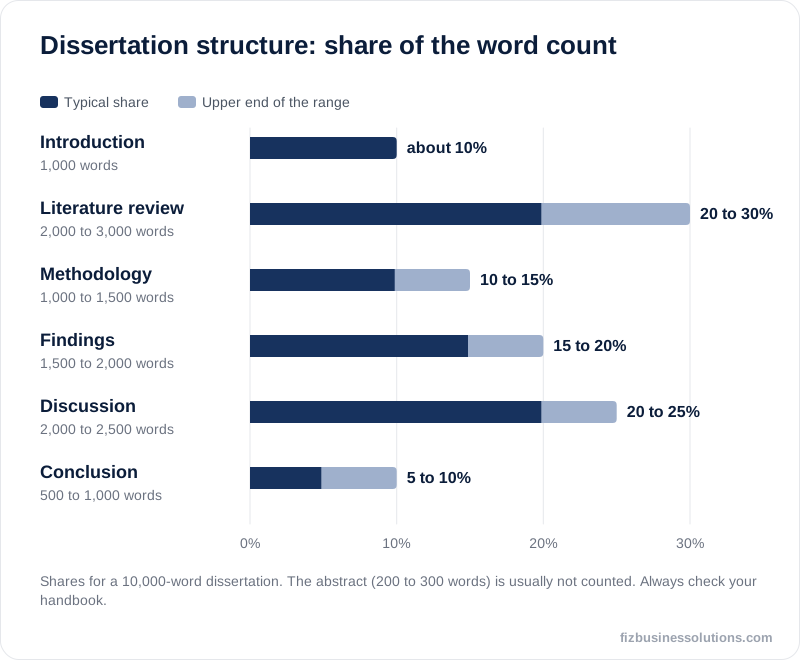
Most empirical dissertations follow a similar structure. The percentages below are typical guides, not fixed rules, and the example figures are based on a 10,000-word dissertation. Your department may set its own breakdown, so always check. Title page, abstract, contents, references and appendices usually do not count towards the word limit, but confirm this in your handbook.
Abstract (around 200 to 300 words, usually not counted)
A short summary of your aim, method, key findings and conclusion. Write it last, once you know exactly what you found.
Introduction (about 10%, roughly 1,000 words)
Set the context, explain the problem, state your research question, aims and objectives, and outline the structure of the dissertation. A reader should know exactly what you are investigating and why by the end of this chapter.
Literature review (about 20 to 30%, roughly 2,000 to 3,000 words)
Critically discuss the key theories, models and studies relevant to your question. Organise by themes rather than summarising one source after another, compare authors, and finish by showing the gap your research addresses.
Methodology (about 10 to 15%, roughly 1,000 to 1,500 words)
Explain and justify your research philosophy, approach, design, sampling, data collection, analysis, ethics and limitations. Justification matters more than description: say why your choices suit your question.
Findings or results (about 15 to 20%, roughly 1,500 to 2,000 words)
Present what you found clearly and objectively, using tables, charts or themes with supporting quotes. Some departments combine findings and discussion into one chapter.
Discussion (about 20 to 25%, roughly 2,000 to 2,500 words)
Interpret your findings and link them back to the literature. Do your results support, challenge or extend previous research? This is often where the highest marks are won or lost.
Conclusion and recommendations (about 5 to 10%, roughly 500 to 1,000 words)
Answer the research question directly, summarise how each objective was met, state your contribution, acknowledge limitations and suggest future research or practical recommendations. Do not introduce new evidence here.
Working with your dissertation supervisor
Your supervisor is there to guide you, not to manage the project for you. Students who get the most from supervision treat each meeting as a working session with a clear agenda.
- Send a short agenda or specific questions a few days before each meeting.
- Submit draft sections early, even if they are rough. Feedback on a weak draft is more useful than no feedback on a perfect plan.
- Keep a record of the advice you receive and the actions you agreed.
- Ask how much draft reading they will do, since many UK universities limit how much of the final draft a supervisor can review.
- If you disagree with feedback, discuss it with evidence rather than ignoring it.
- Raise problems (illness, data access, falling behind) early, when there is still time to adjust.
Writing up: how to get words on the page
You do not need to write chapters in order. Many students find it easiest to start with the methodology, because it describes what you did, then write the literature review, findings and discussion, and finish with the introduction, conclusion and abstract.
Aim for a consistent thread. Every chapter should connect to your research question, and the conclusion should answer it in the same terms you used in the introduction.
- Write a rough first draft quickly, then improve it. Editing is easier than starting from a blank page.
- Use signposting: start each chapter with what it covers and end with a short link to the next.
- Reference as you go in your required style (Harvard, APA, MLA, OSCOLA and so on) so you do not lose sources later.
- Keep paragraphs focused on one point, supported by evidence and followed by your own analysis.
- Back up your work in at least two places, such as cloud storage and an external drive.
Editing and proofreading your dissertation
Leave at least one to two weeks for editing. It is best done in separate passes, each with a different focus, rather than trying to fix everything at once. If you would like a second pair of eyes, FIZBS offers proofreading and editing support from £12 per 1,000 words.
- 1Structure pass: does each chapter do its job, and does the argument flow from question to conclusion?
- 2Content pass: is every claim supported, and is there enough critical analysis rather than description?
- 3Word count pass: trim repetition and long quotes if you are over the limit.
- 4Language pass: grammar, spelling (British English), sentence length and clarity.
- 5Referencing pass: every in-text citation appears in the reference list and vice versa, in the correct style.
- 6Formatting pass: headings, page numbers, table and figure labels, contents page and appendices.
Tip: Read your work aloud or change the font before your final read. Seeing the text differently makes typing errors and clumsy sentences much easier to spot.
Common dissertation mistakes to avoid
- A research question that is too broad, too vague or impossible to answer with the data available.
- A literature review that describes sources one by one instead of comparing and critiquing them.
- A methodology that describes methods without justifying why they suit the question.
- Findings and discussion that never link back to the literature review.
- A conclusion that introduces new material or fails to answer the research question.
- Leaving ethics approval too late and delaying data collection.
- Inconsistent or incomplete referencing.
- Ignoring the marking criteria in the module handbook.
- Going significantly over or under the word limit.
- Leaving no time for editing and proofreading before the deadline.
Need help with your dissertation?
If you are stuck at any stage, from refining your research question to structuring your chapters or checking your analysis, FIZBS can help. Our experts hold Master's and PhD qualifications and have supported students since 2015 across more than 115 subjects, with particular strength in business, management, marketing and finance.
You can message us on WhatsApp 24/7 or book a WhatsApp call with an expert before you decide anything. Dissertation support is priced at £30 per 1,000 words, and all support is 100% confidential.
Reference your sources in seconds
Paste a DOI, ISBN or web link into our free Harvard referencing generator and get the full reference and in-text citation, ready to copy into your work. Using APA 7? Try the free APA referencing generator.