Quick answer
The discussion chapter interprets your findings and explains what they mean. Briefly restate your aim, then for each key finding explain its meaning, compare it with the studies in your literature review, account for differences or surprises and set out the implications. Finish with the main limitations and a link to your conclusion. It is often about 20 to 25% of the word count.
The discussion is often the chapter that separates a good dissertation from an excellent one. Your findings chapter shows what you found. The discussion explains what it means: how your results answer your research questions, how they compare with the studies in your literature review, and why they matter.
Many students find this chapter hard because it asks for interpretation rather than description. The good news is that a discussion follows a predictable logic, and once you have a structure and a pattern for each paragraph, it becomes much easier to write.
This guide covers what the discussion is for, how long it should be, a chapter structure, a simple pattern for discussing each finding with an example, useful phrases and the mistakes that cost the most marks.
What the discussion chapter is for
The discussion interprets your findings in the light of your research questions and the literature. It answers the question every marker is asking: so what?
- Explain what each key finding means
- Show how the findings answer your research questions
- Compare your results with the studies in your literature review
- Account for unexpected or contradictory results
- Set out the theoretical and practical implications
- Acknowledge the limitations of your study
Tip: A quick test: the findings chapter says what happened; the discussion says why it matters and how it fits with what we already know.
How long should the discussion be?
In many dissertations the discussion is one of the longest chapters, often around 20 to 25% of the total word count, which is roughly 2,000 to 2,500 words in a 10,000-word dissertation. Some departments ask for a combined findings and discussion chapter instead. Always follow your handbook.
Discussion chapter structure
Most discussion chapters follow this order. You can organise the middle sections by research question or by theme.
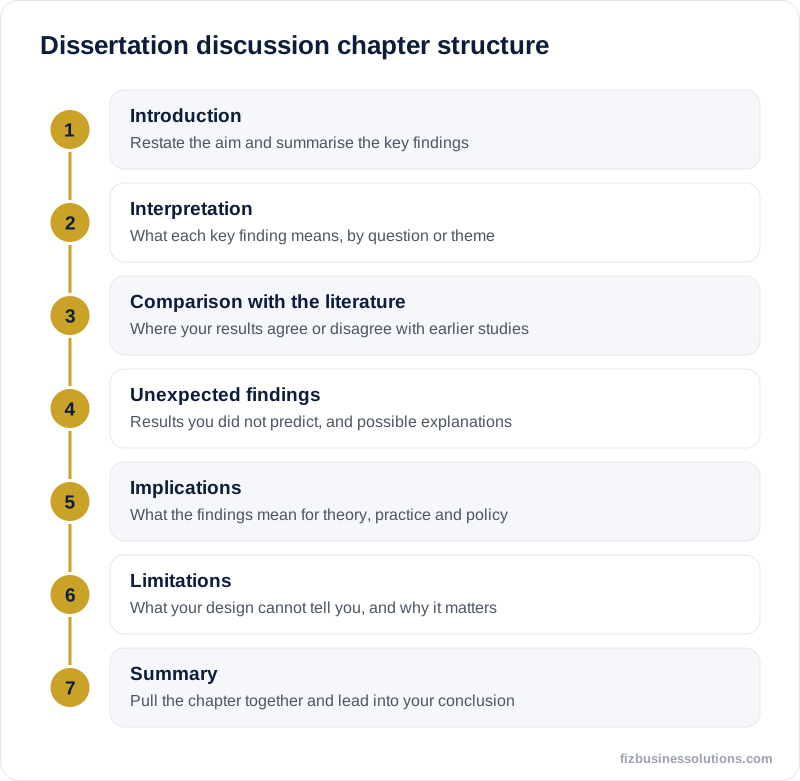
- 1Introduction: briefly restate the aim and summarise the key findings in a few sentences.
- 2Interpretation: explain what each key finding means, one research question or theme at a time.
- 3Comparison with the literature: show where your results agree or disagree with previous studies, and suggest why.
- 4Unexpected findings: discuss results you did not predict and possible explanations.
- 5Implications: explain what the findings mean for theory, for practice and, where relevant, for policy.
- 6Limitations: be honest about what your design cannot tell you and how this affects interpretation.
- 7Summary: pull the chapter together and lead into your conclusion.
How to discuss each finding: a simple pattern
A reliable way to write each discussion paragraph is to move through five steps. It keeps you focused on interpretation and stops the paragraph slipping back into description.
- 1Finding: state the result briefly, without repeating all the numbers or quotes.
- 2Meaning: explain what the result tells you in relation to your research question.
- 3Literature: compare it with specific studies from your literature review.
- 4Explanation: suggest why your result agrees or differs, for example because of your context, sample or method.
- 5Implication: say what follows for theory or practice.
An example discussion paragraph
The illustrative paragraph below comes from an imagined study of line manager support and employee engagement in UK hospitals. The authors and results are invented to show the pattern, so do not cite them.
'The strongest predictor of engagement in this study was perceived line manager support. This suggests that, for ward nurses, day-to-day support from an immediate manager matters more than organisation-wide initiatives. The finding is consistent with earlier studies that link supportive supervision to engagement, but the effect here was larger than in research on private sector employees. One explanation may be the high emotional demands of ward work, which make immediate support especially valuable. For hospital managers, the result points to investing in line manager development rather than relying on broad wellbeing programmes.'
Tip: Notice that the example interprets, compares, explains and draws an implication in five sentences, without repeating any statistics from the findings chapter.
Useful phrases for a discussion chapter
Interpreting your findings
- This finding suggests that...
- One interpretation of this result is that...
- Taken together, these results indicate that...
Comparing with the literature
- This result is consistent with the work of... who found that...
- In contrast to earlier studies, this research found...
- This extends previous research by showing that...
Explaining differences and surprises
- A possible explanation for this difference is...
- This unexpected result may reflect...
- The difference may be due to the context of the present study, in which...
Implications and limitations
- These findings have implications for... because...
- For practitioners, this suggests...
- The results should be interpreted with caution because...
Writing about limitations without weakening your work
Every study has limitations, and markers expect you to recognise them. The aim is to show judgement, not to undermine your own work. For each limitation, say what it is, how it might affect your results, and what future research could do about it. Focus on the two or three limitations that matter most, such as sample size, a single setting, self-reported data or the time available.
Quantitative and qualitative discussions
In a quantitative study, the discussion explains what your statistical results mean in practice, including the size of effects, not only whether they were significant. Avoid claiming cause and effect from correlations.
In a qualitative study, the discussion explains what your themes reveal about participants' experiences and how they relate to existing theory. Use a few short quotations only where they strengthen the interpretation, and avoid generalising beyond your participants.
Common discussion chapter mistakes
- Repeating the findings instead of interpreting them
- Never referring back to the literature review
- Introducing lots of new literature that was not in the review
- Ignoring results that did not support your expectations
- Claiming more than the data can show, for example cause from correlation
- Leaving out limitations, or listing them with no comment on their effect
- Making recommendations here that belong in the conclusion
Discussion chapter checklist
- Every research question is addressed
- Each key finding is interpreted, not just restated
- Findings are compared with specific studies from your literature review
- Unexpected results are explained
- Implications for theory and practice are clear
- The main limitations and their effects are discussed
- The chapter leads naturally into your conclusion
Reference your sources in seconds
Paste a DOI, ISBN or web link into our free Harvard referencing generator and get the full reference and in-text citation, ready to copy into your work. Using APA 7? Try the free APA referencing generator.