Quick answer
An abstract is a short summary of your whole study, usually 150 to 300 words. A simple five-part structure works well: the background, the aim, the method, the key findings and the conclusion or implications. Write it last, in the past tense for what you did, and stay within the word limit.
The abstract is often the shortest part of a dissertation or research paper, yet it is one of the most read. Markers, examiners and journal editors use it to decide what your study is about before they read anything else. Knowing how to write an abstract well means you can summarise months of work in a single, clear paragraph.
Most abstracts are between 150 and 300 words, although dissertations sometimes allow more. The exact limit depends on your university or journal, so always check the guidance. What matters most is that the abstract covers the whole study: why you did it, how you did it, what you found and what it means.
This guide gives you a simple structure, explains common rules about tense and keywords, and includes four illustrative examples, for qualitative, quantitative and literature-based studies, that you can use as models.
What is an abstract?
An abstract is a self-contained summary of your research. Someone should be able to read only the abstract and understand the purpose, method, main findings and conclusion of your study. It is not an introduction, and it is not a teaser that hides the results.
In a dissertation, the abstract usually appears on its own page after the title page and acknowledgements and before the contents page. In a journal article it appears directly under the title and author details.
The five-part abstract structure
A reliable structure for most subjects is to give one or two sentences to each of these five parts:
- 1Context: the topic and why it matters.
- 2Aim: what the study set out to do (the aim or research question).
- 3Method: how you did it (design, sample, data collection and analysis).
- 4Findings: the main results.
- 5Conclusion and implications: what the results mean and why they matter.
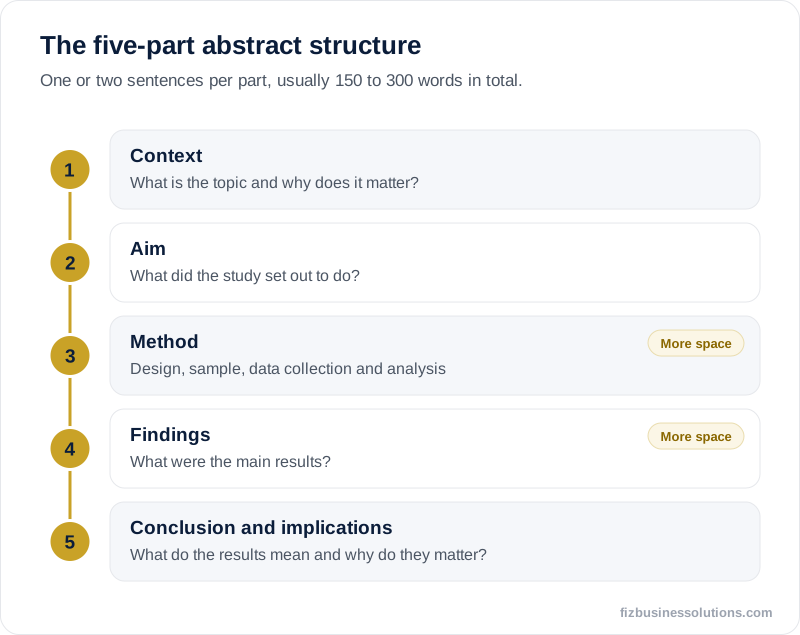
Tip: Give the most space to method and findings. Many weak abstracts spend half their words on background and leave the results vague.
How to write each part
Context and aim
Open with one sentence on the topic and the problem, then state your aim clearly. Avoid long background explanations; one sentence of context is usually enough.
Method
State your research design (for example qualitative, quantitative or mixed methods), your sample (who and how many), how you collected data (survey, interviews, secondary data) and how you analysed it (for example regression in SPSS or thematic analysis).
Findings
Report your most important results specifically. In a quantitative study, mention the key relationships or differences. In a qualitative study, name the main themes. Avoid vague phrases such as "interesting results were found".
Conclusion and implications
End with what your findings mean for theory, practice or policy, and, if useful, one recommendation. Keep it in proportion to the size of your study.
Tense, voice and style
- Use the past tense for what you did and found: "Data were collected", "The findings showed".
- Use the present tense for general facts and conclusions: "These results suggest".
- Follow your subject's convention on "I" or "we" versus the passive voice; many UK business and social science departments accept either if used consistently.
- Avoid abbreviations, citations and references unless your guidance allows them.
- Write it as one paragraph unless a structured abstract with headings is required.
An example dissertation abstract
The example below is illustrative and describes an invented study. It is about 190 words.
"Hybrid working has become common in professional services, yet little is known about how small firms maintain employee engagement in hybrid teams. This study aimed to explore how managers in small and medium-sized UK accounting firms support engagement in hybrid teams. A qualitative design was adopted, using semi-structured interviews with 12 managers and employees from five firms. Data were analysed using thematic analysis. Three themes emerged: the importance of informal check-ins, uneven access to development opportunities, and unclear expectations about availability. Employees valued regular, informal contact with managers more than formal engagement schemes, but junior staff felt less visible when working remotely. The findings suggest that small firms can improve engagement through structured but informal communication routines and fairer allocation of development opportunities. The study contributes to research on hybrid working by highlighting the experiences of smaller firms, and it offers practical recommendations for managers in the sector."
More abstract examples for different types of study
Each example below is illustrative and describes an invented study, so do not cite it. Notice how every example gives most of its words to the method and findings, and ends with what the results mean.
Quantitative abstract example (marketing, about 170 words)
"Social media influencers are widely used in fashion marketing, but evidence on how trust in influencers affects purchase intention among young UK consumers remains limited. This study examined the relationship between perceived influencer credibility and purchase intention among consumers aged 18 to 25. A quantitative cross-sectional design was used, with an online questionnaire completed by 214 respondents recruited through social media. Credibility was measured across trustworthiness, expertise and attractiveness, and the data were analysed using correlation and multiple regression in SPSS. Trustworthiness was the strongest predictor of purchase intention, while attractiveness had no significant effect once the other dimensions were controlled for. The findings suggest that fashion brands should choose influencers whose audiences regard them as honest rather than simply popular. Because the sample was self-selected and limited to one age group, further research with broader samples is recommended."
Qualitative abstract example (nursing, about 160 words)
"Newly qualified nurses often describe their first year in practice as stressful, and preceptorship programmes are intended to support this transition. This study explored newly qualified nurses' experiences of preceptorship on adult wards in one NHS trust. A qualitative descriptive design was used, with semi-structured interviews conducted with eight nurses in their first year of practice, and the transcripts were analysed using reflexive thematic analysis. Three themes were identified: protected time as the foundation of support, the preceptor as a role model, and learning to ask for help. Participants valued preceptorship most when meetings were protected from ward pressures, and several felt unsupported when staffing shortages cancelled sessions. The findings indicate that the value of preceptorship depends less on its formal content than on whether time is reliably protected. Trusts may strengthen support by scheduling preceptorship time in advance and monitoring cancellations."
Literature review abstract example (education, about 165 words)
"Retrieval practice, in which learners recall information from memory, is widely promoted in UK schools, but its effectiveness in everyday secondary classrooms is less clear than in laboratory studies. This dissertation reviewed classroom-based research on retrieval practice in secondary education published between 2010 and 2025. A systematic search of ERIC and the British Education Index identified 23 studies that met the inclusion criteria, which were appraised for quality and synthesised thematically. Most studies reported improved recall of factual knowledge, particularly when low-stakes quizzes were spaced over time. Evidence for benefits to higher-order skills, such as extended writing, was limited and mixed, and few studies followed students for longer than one term. The review concludes that retrieval practice is a useful strategy for consolidating knowledge, but that claims about wider benefits are not yet well supported. Longer-term classroom studies across a wider range of subjects are recommended."
Tip: Compare the three examples: the quantitative one names variables and the direction of results, the qualitative one names its themes, and the literature review states how sources were found and what patterns they showed.
Keywords
Many universities and journals ask for three to six keywords below the abstract. Choose words and short phrases someone would use to search for your study, such as "hybrid working", "employee engagement", "SMEs" and "accounting firms". Avoid repeating words already in your title if your guidance asks for different terms.
When to write the abstract
Write the abstract last, after your findings, discussion and conclusion are complete. Only then do you know exactly what you found and what it means. If you write it early, it will probably promise things your final dissertation does not deliver.
Abstract checklist and common mistakes
- Within the word limit set by your university or journal.
- Covers context, aim, method, findings and conclusion.
- States the actual findings, not just that findings were made.
- No new information that is not in the main text.
- No citations or undefined abbreviations (unless allowed).
- Matches your title, research questions and conclusion.
- Proofread carefully, because errors here are noticed immediately.
Abstracts for different types of study
Quantitative study
Mention the design, sample size, main variables and the key statistical results in plain terms, for example that a positive relationship was found between two variables or that one group scored higher than another. Avoid reporting every statistic; one or two key figures are enough if your field expects them.
Qualitative study
Describe the participants, the method of data collection (such as semi-structured interviews or focus groups) and the analysis approach, then name the main themes. Show briefly what each theme means rather than listing theme titles only.
Literature-based or secondary research
Explain how you selected and analysed the sources, for example a systematic search of named databases with clear inclusion criteria, then summarise the main patterns, gaps and conclusions you identified.
How to cut an abstract down to the word limit
Most first drafts are too long. Cutting them is easier if you work in a set order rather than trimming words at random.
- 1Delete background sentences until only one sentence of context remains.
- 2Remove phrases such as "this study will discuss" and "it was found that" and state the point directly.
- 3Replace long method descriptions with the essentials: design, sample, data collection, analysis.
- 4Keep only the two or three most important findings.
- 5Combine the conclusion and implication into one sentence.
- 6Read it aloud and remove any word that does not add meaning.
Need help with your abstract or dissertation?
FIZBS experts can review your abstract against your full dissertation and suggest how to make it clearer and more complete. Proofreading starts from £12 per 1,000 words and dissertation support is £30 per 1,000 words. Message us on WhatsApp at any time, and new customers get 10% off their first order.