Quick answer
To write a case study analysis, read the case and brief carefully, identify the key issues, analyse them with relevant theory and frameworks, generate and evaluate options against clear criteria, and finish with practical recommendations and an implementation plan. Support each point with evidence from the case.
Case study assignments are popular in business, management, MBA, nursing, law and education courses because they mirror real decisions. You are given a situation, often a company or a patient scenario, and asked to analyse what is happening and recommend what should be done. Knowing how to write a case study analysis means you can move from description to diagnosis to action.
The biggest mistake students make is retelling the case. Your marker already knows the story. What they want to see is your analysis: which issues matter most, why they have happened, which theories explain them and what realistic options exist.
This guide gives you a step-by-step method, a standard structure and a short worked example using a fictional company.
Step 1: Read the case and the brief carefully
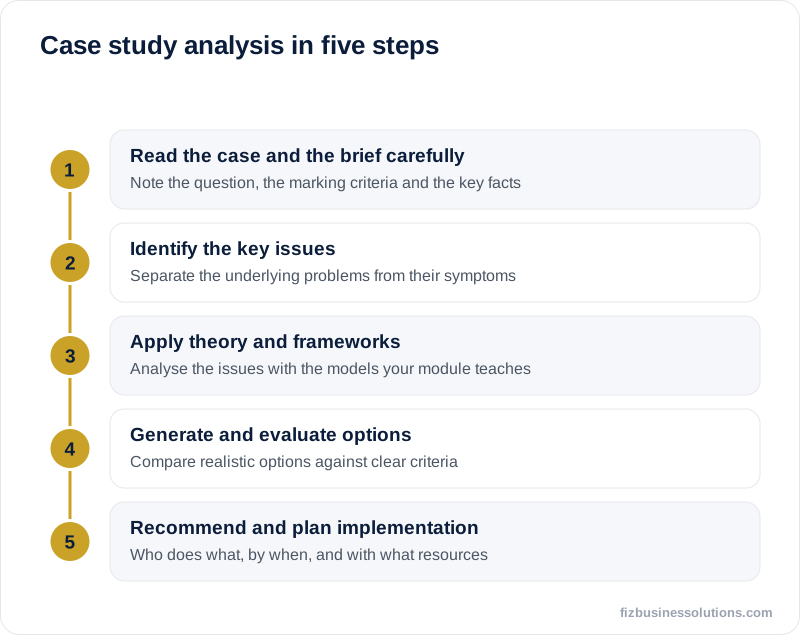
Read the case at least twice. The first time, read for the overall story. The second time, highlight facts, figures, quotes and tensions. Then read the assignment brief and marking criteria closely: are you asked to analyse problems, evaluate a strategy, recommend actions, or all three?
Make a quick list of the stakeholders involved (managers, employees, customers, suppliers, regulators) and what each of them wants. Conflicts between stakeholders are often where the key issues lie.
Step 2: Identify the key issues
List every problem you notice, then group and prioritise them. Distinguish between symptoms (for example falling sales, high staff turnover) and underlying causes (for example poor leadership, unclear strategy, outdated systems). Your analysis should focus on causes, because recommendations aimed only at symptoms rarely work.
Tip: Ask "why?" several times for each symptom. Falling sales, why? Customers are switching. Why? A competitor offers faster delivery. Why can we not match it? Our supply chain is slow. Now you have reached a cause you can address.
Step 3: Apply theory and frameworks
Markers expect you to use the models and theories taught on your module to explain the issues. Choose the ones that genuinely fit the case rather than forcing in every framework you know.
- Strategy: PESTLE, Porter's Five Forces, SWOT, resource-based view, Ansoff matrix.
- Leadership and HR: leadership styles, motivation theories, organisational culture models.
- Change management: Lewin's three-stage model, Kotter's eight steps.
- Marketing: segmentation, targeting and positioning, the marketing mix.
- Finance: ratio analysis, investment appraisal.
- Health and social care: relevant clinical guidance, reflective models and professional codes.
Step 4: Generate and evaluate options
For your main issues, identify two or three realistic options. Evaluate each against clear criteria, for example cost, time, risk, fit with the organisation's resources and impact on stakeholders. A short table comparing options against criteria can make this section very clear.
Showing that you considered alternatives, and explaining why you rejected some, demonstrates critical thinking and earns higher marks than jumping straight to one answer.
Step 5: Make recommendations and plan implementation
Recommend the option or combination of options that best addresses the key causes. Explain how it should be implemented: who is responsible, what resources are needed, the timescale and how success will be measured. Linking recommendations to an implementation plan shows practical understanding.
Case study analysis format: the parts of a case analysis
Some briefs ask for an essay format and others a report format with numbered headings. Follow your brief.
- 1Introduction: purpose, the organisation or scenario, and the structure.
- 2Background summary: a brief overview of the case (keep it short).
- 3Identification of key issues, prioritised.
- 4Analysis of each issue using theory and evidence from the case.
- 5Evaluation of alternative solutions.
- 6Recommendations and implementation plan.
- 7Conclusion.
- 8References and any appendices.
A short worked example
The following mini example is fictional and shortened, but it shows the method in action.
Case: "Northfield Bikes", a family-owned UK bicycle retailer, has seen online sales fall for two years while staff turnover in its stores has risen.
Key issues: the symptom is falling online sales; analysis suggests the causes are an outdated website, slower delivery than larger competitors, and low staff engagement linked to limited training and unclear roles.
Theory applied: Porter's Five Forces shows high rivalry and low switching costs online. Herzberg's two-factor theory helps explain why pay rises alone have not reduced turnover, as staff cite lack of recognition and development.
Options: (1) invest in a new e-commerce platform; (2) partner with a third-party delivery service; (3) introduce a structured training and recognition programme.
Recommendation: combine options 2 and 3 in the short term because they are lower cost and address both causes, then review the website investment in year two.
How to write a case study analysis in an MBA
MBA case studies, often in the Harvard Business School style, put you in the position of a senior manager who has to make a decision. They are longer, include financial exhibits and leave the answer open on purpose, so markers look closely at your judgement as well as your use of theory.
- Start from the decision: state the question the protagonist faces in one sentence, and keep every section connected to it.
- Use the exhibits: work out the key numbers yourself, such as margins, growth, cash flow or break-even, and put detailed workings in an appendix.
- Choose strategic frameworks that fit: for example the value chain, VRIO, Porter's generic strategies or Ansoff's matrix, applied to the facts of the case.
- Weigh options against clear criteria such as cost, risk, fit with strategy and speed, and say what you would give up with each choice.
- Make a decision: MBA markers expect a clear recommendation with an implementation plan, risks and how you would measure success.
Referencing the case and using evidence
Reference the case study itself in your chosen style, as well as academic sources and any additional data you use. Use specific evidence from the case, such as figures, quotes and events, to support each point in your analysis. Statements without evidence look like opinion.
Case studies in health, law and education
Nursing and health care
Health case studies usually focus on a patient scenario. Anonymise the patient, follow your professional code on confidentiality, and structure the analysis around assessment, planning, implementation and evaluation, supported by clinical guidance and research evidence. Many courses also expect a reflective element.
Law
Law problem questions are a form of case study. A common approach is to identify the legal issue, state the relevant rule from legislation and case law, apply the rule to the facts and reach a conclusion, often taught as IRAC. Reference cases and statutes in OSCOLA unless told otherwise.
Education
Education case studies often examine a learner, a class or a school initiative. Link your analysis to learning theories, curriculum guidance and evidence on effective practice, and make recommendations that are realistic within the school context.
Using evaluation criteria to compare options
A simple scoring table can make your evaluation clear and convincing. List your options in rows and your criteria in columns, then explain your judgement for each one in the text.
- Suitability: does the option address the key causes you identified?
- Feasibility: does the organisation have the money, skills and time to deliver it?
- Acceptability: will key stakeholders, such as staff, customers and owners, support it?
- Risk: what could go wrong, and how could the risk be reduced?
- Impact: how much difference will it make, and how quickly?
Tip: Do not let the table replace your reasoning. Markers reward the explanation behind each judgement, not the numbers in the grid.
Common case study mistakes
- Retelling the case instead of analysing it.
- Listing frameworks without applying them to the specific situation.
- Treating symptoms rather than causes.
- Recommending one solution without evaluating alternatives.
- Recommendations that ignore cost, resources or practicality.
- Not using evidence from the case to support points.
Need help with a case study assignment?
FIZBS experts support business, management, MBA, nursing and law students with case study analysis, from identifying key issues to building strong recommendations. Support starts from £20 per 1,000 words, new customers get 10% off, and you can message us on WhatsApp 24/7 or book a WhatsApp call with an expert (in English).
Reference your sources in seconds
Paste a DOI, ISBN or web link into our free Harvard referencing generator and get the full reference and in-text citation, ready to copy into your work. Using APA 7? Try the free APA referencing generator.