Quick answer
A university business report usually has a title page, an executive summary, contents, an introduction, numbered sections of findings and analysis, conclusions, recommendations, references and appendices. Unlike an essay, it uses headings, tables and charts, and the executive summary gives the key findings and recommendations on one page.
Business reports are one of the most common assessments on business, management, MBA, marketing and accounting courses in the UK and Saudi Arabia. They test whether you can analyse a real or realistic situation and give clear, evidence-based advice. Knowing how to write a business report properly is a skill employers value too.
A report is not an essay with headings added. It has a specific format, it is written for a decision-maker, and it is designed to be scanned quickly. Markers look for clear structure, sound use of theory and data, and recommendations that follow logically from your analysis.
This guide explains the standard business report format, how to write each section, and how to avoid the mistakes that most often lose marks.
Business report vs essay
- Purpose: an essay argues a position; a report analyses a problem and recommends action.
- Audience: an essay is written for an academic reader; a report is written for a manager or client, even in a university assignment.
- Format: reports use numbered headings, an executive summary, and often tables, charts and appendices.
- Style: reports are concise and direct, with short paragraphs and clear topic sentences.
- Ending: an essay ends with a conclusion; a report ends with conclusions and recommendations.
Standard business report format
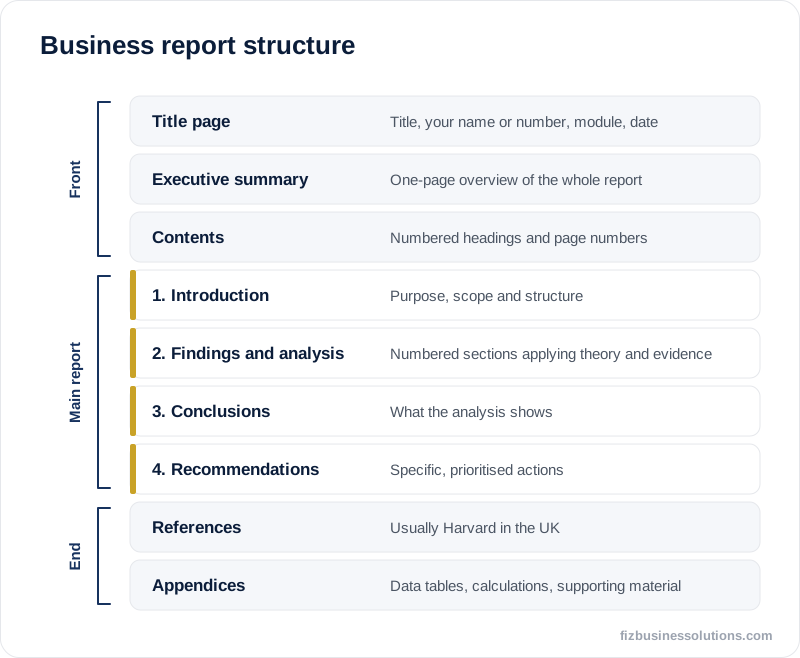
Unless your brief says otherwise, most university business reports use this order:
- 1Title page: report title, your name or student number, module, date.
- 2Executive summary: a one-page overview of the whole report.
- 3Table of contents: numbered headings and page numbers.
- 4Introduction: purpose, scope and structure of the report.
- 5Main body (findings and analysis): numbered sections applying theory and evidence.
- 6Conclusions: what the analysis shows.
- 7Recommendations: specific actions, often prioritised.
- 8References: in the required style, usually Harvard in the UK.
- 9Appendices: supporting material such as data tables or calculations.
How to write the executive summary
The executive summary is written last but appears first. It should let a busy manager understand the whole report in a minute or two. Include the purpose, the main findings, the conclusions and the key recommendations. Keep it to roughly 10% of the word count or one page, whichever your brief suggests.
Do not write it as an introduction. An introduction says what the report will do; an executive summary says what it found and what it recommends.
Tip: Check whether the executive summary counts towards your word limit. Many UK modules exclude it, but some include it.
Writing the introduction
The introduction sets out the purpose of the report, the organisation or situation being analysed, the scope (what is and is not covered) and how the report is organised. It is usually short, around 5% to 10% of the word count.
Writing the main body: findings and analysis
This is where most of your marks come from. Divide the main body into numbered sections and subsections (1.0, 1.1, 1.2 and so on) that each address one issue. In each section, present evidence, apply relevant theory or frameworks, and analyse what it means for the organisation.
Typical frameworks include PESTLE for the external environment, Porter's Five Forces for industry competition, SWOT for internal and external factors, the marketing mix for marketing reports and ratio analysis for financial reports. Use the frameworks your module taught, and do not just list points: explain why each factor matters and how strongly it affects the organisation.
- Start each section with a clear topic sentence.
- Support claims with academic sources, company reports or credible data.
- Use tables and charts where they make data easier to understand, and refer to them in the text.
- Keep long calculations or raw data in the appendices.
Writing conclusions and recommendations
Conclusions summarise what your analysis has shown, without introducing new information. Recommendations turn those conclusions into actions. Each recommendation should say what should be done, by whom, why (linked to your findings) and, where possible, when and at what cost.
Many markers like recommendations presented in a short table with columns for action, responsibility, timescale and expected outcome. Prioritise the most important actions first.
Business report outline (sample)
Here is an illustrative business report outline for a 3,000-word report on a fictional mid-sized UK coffee chain considering expansion. You can adapt the headings and word counts to your own brief:
- Executive summary (counts separately).
- 1.0 Introduction (250 words): purpose, scope, structure.
- 2.0 External analysis (700 words): PESTLE and Porter's Five Forces.
- 3.0 Internal analysis (600 words): resources, capabilities and financial position.
- 4.0 SWOT summary (300 words): linking internal and external findings.
- 5.0 Strategic options (600 words): evaluating two or three expansion options.
- 6.0 Conclusions (250 words).
- 7.0 Recommendations (300 words): actions, responsibilities, timescales.
- References and appendices.
Business report example: executive summary and recommendations
Students often ask for a business report example, so here are two short, illustrative extracts from the fictional coffee chain report above. They show the tone and level of detail markers expect, not text to copy.
Example executive summary: "This report assesses whether Harbour Coffee Ltd (a fictional 24-store UK chain) should expand into the North West. External analysis shows strong demand in city centres but intense rivalry from national chains. Internally, the company has a loyal customer base and healthy cash reserves, but limited management capacity. Three options were evaluated: opening company-owned stores, franchising and expanding through drive-through sites. The report recommends a phased opening of four company-owned stores in Manchester over 18 months, funded from retained profit, with a review after the first two stores."
- Example recommendation 1: open two stores in central Manchester by June 2027, led by the operations director, with a combined budget of £450,000.
- Example recommendation 2: recruit and train two area managers before the first opening to protect service quality.
- Example recommendation 3: review sales and customer feedback after six months, and open the next two stores only if each site reaches its break-even sales target.
Tip: Good recommendations say what should be done, who is responsible, when, and how success will be measured. Each one should follow from a finding in your analysis.
Management reports and other types of business report
The same structure works for most reports you will meet at university and at work, with small changes in emphasis:
- Formal (long) business report: the full structure in this guide, used for most university assignments and consultancy-style tasks.
- Management report: written for managers inside an organisation, usually shorter, focused on performance against targets, problems and actions.
- Feasibility report: assesses whether a project or idea is practical, often with costs, risks and a clear go or no-go recommendation.
- Short (informal) report or memo report: one or two pages with a brief introduction, findings and recommendations, often without an executive summary.
How long does it take to write a business report?
As a rough guide, a 2,500 to 3,000-word university business report usually takes one to two weeks of steady work: two or three days to research the organisation and gather data, a day to plan the structure and word allocation, three or four days to draft, and one or two days to edit, check references and format. Group reports and reports with detailed financial analysis need longer, so start as soon as the brief is released.
Using data, tables and charts effectively
Numbers make a business report persuasive, but only if you explain them. Every table or chart should have a number and a clear title, a source line underneath, and a sentence in the text that tells the reader what it shows and why it matters. Never leave a chart to speak for itself.
Use credible data: published company annual reports, government statistics, industry reports and academic studies. Calculate ratios or growth rates where they help your argument, and put detailed workings in an appendix.
Tip: A strong pattern: "As Table 2 shows, gross margin fell from 42% to 36% over three years, which suggests rising input costs are not being passed on to customers." State the figure, then interpret it.
Writing style for business reports
- Write in a formal but direct style, using the third person unless your brief asks for a reflective section.
- Keep paragraphs short, ideally three to five sentences, each focused on one point.
- Use active verbs: "the company should reduce" rather than "a reduction should be considered".
- Define technical terms and abbreviations the first time you use them.
- Use consistent numbering for headings, tables and figures.
- Support every major claim with evidence and a reference.
How business reports are marked
Marking criteria vary, but most UK business schools reward the same core qualities: a clear structure that follows report conventions, accurate and relevant use of theory, analysis that goes beyond description, use of credible evidence, recommendations that follow logically from the analysis, and correct referencing and presentation.
Before submitting, check your report against the marking rubric line by line. If the rubric gives a high weighting to critical analysis, make sure every main section explains why factors matter and how they affect the organisation, not just what they are.
Common business report mistakes
- Writing in essay style with long paragraphs and no numbered headings.
- Describing frameworks without applying them to the organisation.
- Using lots of data without explaining what it means.
- Recommendations that do not follow from the analysis.
- Treating the executive summary as an introduction.
- Weak referencing of company data and websites.
- Ignoring the word count allocation for each section.
Need help with your business report?
Business, management and MBA assignments are FIZBS's strongest area. Our Master's and PhD-qualified experts can help you structure your report, apply the right frameworks and strengthen your analysis and recommendations. Support starts from £20 per 1,000 words with 10% off your first order, and you can message us on WhatsApp 24/7 or book a WhatsApp call with an expert (in English).
Reference your sources in seconds
Paste a DOI, ISBN or web link into our free Harvard referencing generator and get the full reference and in-text citation, ready to copy into your work. Using APA 7? Try the free APA referencing generator.