Quick answer
A university essay has an introduction with a clear thesis (about 10% of the words), body paragraphs that each make one point using the PEEL structure (point, evidence, explanation, link), and a conclusion that answers the question (about 10%). Plan before writing, and use critical analysis rather than description to reach the higher grade bands.
Knowing how to structure an essay is one of the biggest differences between a pass and a high mark at university. Markers in the UK rarely penalise you for one weak sentence, but they notice straight away when an essay has no clear argument, wanders between points or ends without answering the question. A good university essay structure makes your thinking easy to follow, and that alone lifts the grade.
This guide walks you through the whole process: building an essay plan, writing an introduction with a clear thesis statement, constructing PEEL and PEEEL paragraphs (with a full example), using critical analysis language, writing a conclusion, planning your word count and proofreading before you submit. The advice applies to most subjects, from business and management to education, nursing and the social sciences. Always check your module handbook and marking criteria, because some departments have their own expectations.
The basic university essay structure
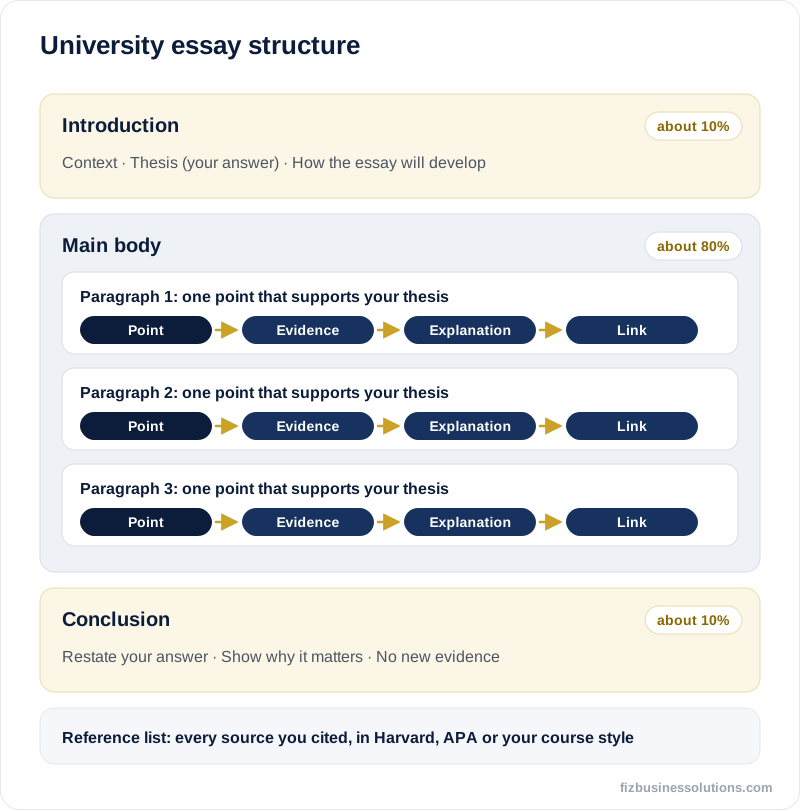
Almost every academic essay at a UK university follows the same three-part shape. What changes from level 4 to Master's level is not the shape but the depth of argument and evidence inside it.
- Introduction (about 10% of the word count): sets the context, answers the question in one or two sentences (your thesis) and tells the reader how the essay will develop.
- Main body (about 80%): a series of paragraphs, each making one point that supports your thesis, backed by evidence and analysis.
- Conclusion (about 10%): pulls the argument together, restates your answer in the light of the evidence and explains why it matters.
- Reference list: every source you cited, in the style your course requires (often Harvard or APA).
Tip: Most essays do not use headings inside the text. Reports, case studies and some business assignments do. If the brief says 'essay', assume continuous prose unless your tutor says otherwise.
Step 1: Unpack the question and build an essay plan
Many weak essays go wrong before a single sentence is written, because the student answers the topic rather than the actual question. Spend time on the question first, then turn it into a plan.
- 1Highlight the command word: discuss, evaluate, critically analyse, compare, to what extent. Each one asks for something different. 'To what extent' needs a judgement, not just a description.
- 2Highlight the topic words and any limits, such as a time period, a sector, a country or a named theory.
- 3Write a one-sentence provisional answer. This becomes your working thesis and keeps your reading focused.
- 4Read and take notes with the question in front of you. Record the author, year and page number next to every note so referencing is easy later.
- 5Group your notes into three to five main points that support (or complicate) your answer. These become your body paragraphs or paragraph clusters.
- 6Order the points logically: from most to least important, from general to specific, or as a balanced 'for, against, judgement' structure.
- 7Give each point a word allowance so you know how much space it gets before you start drafting.
Tip: A simple plan template: Thesis | Point 1 + evidence | Point 2 + evidence | Point 3 + evidence | Counter-argument + response | Conclusion. Fit it on one page. If you cannot, the essay is probably trying to do too much.
How to write an essay introduction
If you are wondering how to write an essay introduction that sounds confident, use a simple formula. A strong introduction moves from broad to narrow, like a funnel, and ends with a clear roadmap. For most 1,500 to 3,000 word essays, one paragraph is enough.
The four-part introduction formula
- Context: one or two sentences showing why the topic matters. Avoid sweeping openers such as 'Since the dawn of time' or 'In today's society'.
- Focus: narrow down to the specific issue the question asks about and define any key terms.
- Thesis statement: your answer to the question, stated clearly.
- Roadmap: one sentence outlining how the essay will develop, for example 'This essay first examines..., then evaluates..., before concluding that...'.
Example introduction (business question)
Question: 'To what extent is financial reward the main driver of employee motivation?'
Example: "Employee motivation is a central concern for organisations seeking to retain staff and improve performance. While pay is often assumed to be the strongest motivator, motivation theories suggest a more complex picture. This essay argues that financial reward is necessary to prevent dissatisfaction but is rarely sufficient on its own to sustain motivation, which depends more on recognition, autonomy and meaningful work. It first examines content theories of motivation, then evaluates evidence on pay and performance, before considering how the balance may differ across sectors."
Writing a strong thesis statement
The thesis statement is the single most important sentence in your essay. It tells the marker what you are arguing, and every paragraph should connect back to it. A good thesis is specific, arguable and directly answers the question.
- Weak: 'This essay will discuss motivation and pay.' (It announces a topic, not an argument.)
- Weak: 'Pay is important for motivation.' (Too obvious to argue against.)
- Strong: 'Financial reward prevents dissatisfaction but is rarely sufficient on its own to sustain motivation.' (A clear position that can be supported and challenged.)
- For 'evaluate' or 'to what extent' questions, show a degree of judgement: 'largely', 'only partly', 'in some contexts but not others'.
Tip: Many students find it easier to write the introduction last. Draft a rough version to guide you, then rewrite it once the body is finished so it matches what you actually argued.
How to write a PEEL paragraph (with an example)
The PEEL paragraph is the most widely taught structure for body paragraphs in UK schools and universities. Each paragraph makes one argument, and the four letters remind you what it needs:
- P: Point. The topic sentence that states the paragraph's argument and links to your thesis.
- E: Evidence. Academic sources, data, case examples or theory that support the point, correctly cited.
- E: Explanation (or Evaluation). What the evidence shows, why it matters and how far it can be trusted.
- L: Link. A closing sentence that connects back to the question or leads into the next paragraph.
PEEEL: adding the extra E for higher marks
Many tutors teach PEEEL, which separates Explanation from Evaluation. The extra step is where critical analysis happens: you weigh the strengths and limits of the evidence, compare it with other authors or apply it to a context. At level 6 and Master's level, the evaluation step is usually what moves an essay from a 2:2 to a 2:1 or First.
Example PEEEL paragraph
"[Point] One reason financial reward alone cannot sustain motivation is that pay mainly prevents dissatisfaction rather than creating satisfaction. [Evidence] Herzberg, Mausner and Snyderman (1959) distinguished between hygiene factors, such as salary and working conditions, and motivators, such as recognition, achievement and responsibility. [Explanation] This suggests that a fair salary removes a source of complaint, but employees are more likely to feel engaged when their work is recognised and gives them a sense of achievement. [Evaluation] However, the two-factor theory has been criticised for relying on what employees recall about good and bad experiences, which may lead them to credit themselves for success and blame external factors for problems. It may also understate the role of pay for lower-paid workers, for whom salary can be a direct source of motivation. [Link] Therefore, while Herzberg's work supports the argument that pay is not the main driver, its relevance appears to depend on the employee's circumstances, which the next section explores."
Tip: Aim for roughly 150 to 300 words per paragraph in most undergraduate essays. If a paragraph runs past a page, it probably contains two points and should be split.
Critical analysis language that markers look for
Description explains what an author said. Critical analysis explains how convincing it is, how it compares with other work and what it means for your argument. Marking criteria at most UK universities reward analysis far more than description. These phrases help you move from one to the other.
Evaluating evidence
- 'This study is limited by its small sample, so its findings may not apply to...'
- 'Although widely cited, this model was developed in a different context and may not reflect...'
- 'The evidence is persuasive in relation to X but less convincing for Y.'
Comparing and contrasting sources
- 'Author A (Year) supports this view, whereas Author B (Year) argues that...'
- 'In contrast to earlier research, more recent studies suggest...'
- 'These findings are consistent with...'
Showing your own judgement
- 'On balance, the evidence suggests that...'
- 'This implies that organisations should...'
- 'A more convincing explanation may be that...'
Tip: Use cautious, academic verbs: suggests, indicates, appears to, may. Avoid 'proves' unless you are describing a mathematical proof.
How to write an essay conclusion
A conclusion should leave the marker in no doubt about your answer. It is not a place for new evidence or sources. Use this structure:
- 1Restate your thesis in fresh words, showing how the evidence has confirmed or refined it.
- 2Summarise the main points briefly and show how they connect, rather than listing them one by one.
- 3Give your final judgement on the question, especially for 'evaluate' or 'to what extent' questions.
- 4Note the wider implications, a limitation of the argument or a direction for future research or practice.
Tip: Try reading only your introduction and conclusion together. If they make sense as a short summary of the essay and agree with each other, your structure is working.
Word count planning: how to structure a 2,000 word essay
Dividing your word count before you write stops you spending 800 words on the first point and rushing the rest. Here is a typical plan for a 2,000 word essay with three main arguments and a counter-argument.
- Introduction: about 200 words (one paragraph).
- Main point 1: about 400 words (one or two PEEL paragraphs).
- Main point 2: about 400 words.
- Main point 3: about 400 words.
- Counter-argument and response: about 300 words.
- Conclusion: about 200 to 300 words.
- Reference list: usually not counted, but check your handbook, as rules on in-text citations and tables vary.
Tip: Some UK universities allow a margin of around 10% above the word limit, but policies differ and some apply penalties for going over. Check your handbook rather than assuming a margin exists.
Common essay structure mistakes
- Describing theories at length without applying them to the question.
- A thesis that is missing, vague or only appears in the conclusion.
- Paragraphs that contain several unrelated points or no clear topic sentence.
- Evidence dropped in without explanation of why it matters.
- Relying on one or two sources, or on non-academic websites, instead of a range of scholarly work.
- Ignoring counter-arguments, which makes the essay look one-sided.
- Introducing new points or sources in the conclusion.
- Running out of words before the final section because there was no word count plan.
Proofreading checklist before you submit
Leave at least a day between finishing your draft and proofreading it if you can. Fresh eyes spot far more. Work through this checklist:
- 1Does the introduction contain a clear thesis that answers the exact question asked?
- 2Does every paragraph have one clear point that links back to the thesis?
- 3Is every claim supported by a cited source, and does every citation appear in the reference list?
- 4Have you included evaluation, not just description, in each main section?
- 5Do the conclusion and introduction agree?
- 6Is the essay within the word limit?
- 7Have you checked spelling (British English), grammar, sentence length and formatting such as font, spacing and page numbers?
- 8Read it aloud. Sentences you stumble over usually need rewriting.
Need help with your university essay?
If you are stuck on a plan, unsure whether your argument is critical enough or simply short on time, FIZBS can help. Our experts hold Master's and PhD qualifications and can give guidance on structure, feedback on drafts and proofreading so your essay reads clearly and meets your marking criteria.
Essay help starts from £20 per 1,000 words and proofreading from £12 per 1,000 words. You can message us on WhatsApp 24/7 for a quick quote, and everything is kept 100% confidential.
Reference your sources in seconds
Paste a DOI, ISBN or web link into our free Harvard referencing generator and get the full reference and in-text citation, ready to copy into your work. Using APA 7? Try the free APA referencing generator.