Quick answer
Gibbs' Reflective Cycle has six stages: Description, Feelings, Evaluation, Analysis, Conclusion and Action plan. Give the most words to Analysis, where you link the experience to theory and evidence, keep Description short, and finish with a specific action plan for next time.
The Gibbs reflective cycle is the model most UK students meet first when they are asked to write a reflective essay. Nursing, midwifery, social work, education and MBA programmes all use it, because it turns a vague instruction ("reflect on your experience") into six clear stages you can write about in order.
Many students still struggle with it. They spend most of the word count describing what happened, write a paragraph about feeling nervous and finish with a generic promise to "communicate better". That earns a pass at best. This guide explains what each stage really asks for, how to share your word count, how to bring in theory, and then shows the whole cycle working in a short example from a nursing placement.
What is the Gibbs reflective cycle?
Graham Gibbs set out the cycle in Learning by Doing: A Guide to Teaching and Learning Methods (Gibbs, 1988), published by the Further Education Unit at Oxford Polytechnic. It built on the idea of experiential learning, where people learn by having an experience, thinking about it and then trying something different next time.
The model has six stages arranged in a loop: Description, Feelings, Evaluation, Analysis, Conclusion and Action plan. Because it is a cycle, the action plan feeds into the next experience, which you can then reflect on again. That is why it suits professional courses where reflection is meant to be ongoing rather than a one-off essay.
Tip: Reference it in Harvard style as: Gibbs, G. (1988) Learning by Doing: A Guide to Teaching and Learning Methods. Oxford: Further Education Unit, Oxford Polytechnic. Check your handbook for the exact referencing style your course uses.
The six stages of the Gibbs reflective cycle explained
Each stage answers a guiding question. Use these questions as prompts when you plan your paragraphs.
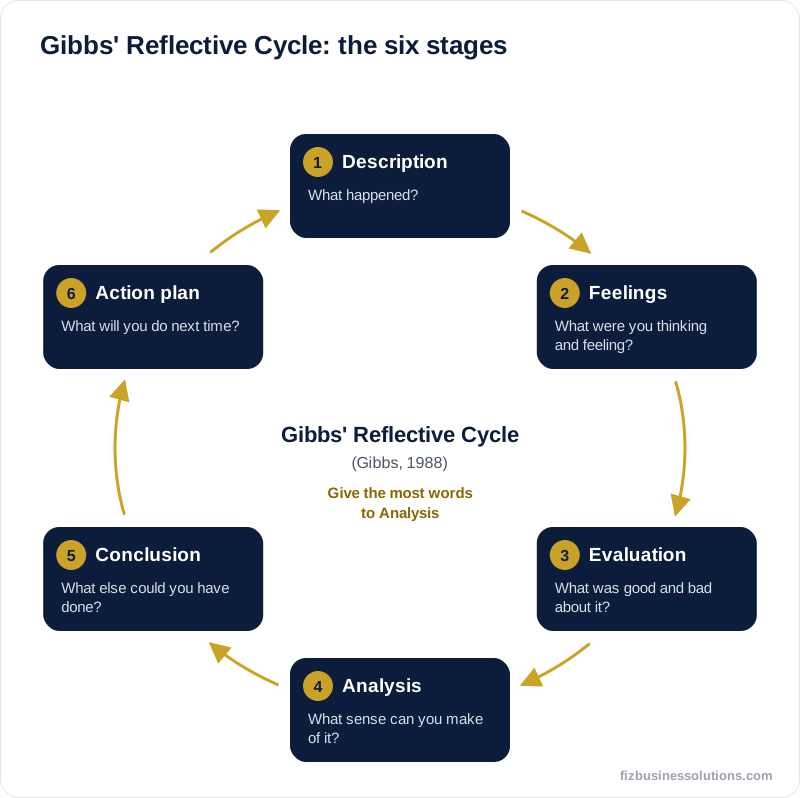
1. Description: what happened?
Set the scene briefly: where you were, who was involved (anonymised), what you did and what the outcome was. Keep it factual and short. No analysis yet.
2. Feelings: what were you thinking and feeling?
Describe your emotions and thoughts before, during and after the event. Be honest. Markers look for self-awareness, and admitting that you felt anxious, defensive or out of your depth is often what makes the later analysis meaningful.
3. Evaluation: what was good and bad about the experience?
Make a balanced judgement. What went well, and what did not? Include both, even if the experience felt mostly negative or mostly positive.
4. Analysis: what sense can you make of the situation?
This is the most important stage. Ask why things went well or badly, and use theory, research, policy or professional standards to explain it. This is where your essay becomes academic rather than a diary entry.
5. Conclusion: what else could you have done?
Summarise what you learned, both about this situation and about yourself or your practice more generally. Consider what you could have done differently.
6. Action plan: what will you do next time?
Set specific, realistic actions with a timescale and say how you will know you have improved. Many students frame this with SMART goals (specific, measurable, achievable, relevant and time-bound).
How many words should each stage get?
A common mistake is to give each stage equal space. Description and feelings should be brief, while analysis carries the most marks because it shows critical thinking. The split below is a sensible starting point for a 1,500-word reflective essay. Adjust it if your marking criteria say otherwise.
- Introduction: around 100 words (what you are reflecting on and which model you are using).
- Description: around 150 to 200 words.
- Feelings: around 150 words.
- Evaluation: around 200 words.
- Analysis: around 450 to 500 words.
- Conclusion: around 150 to 200 words.
- Action plan: around 200 words.
Tip: If your description is longer than your analysis, your balance is wrong. Cut the story back and spend the words explaining why things happened.
First person or third person?
Reflective writing is normally written in the first person ("I felt", "I noticed", "I will"), because you are analysing your own experience. Most UK universities expect this for reflective essays and portfolios. Writing "the student felt anxious" usually sounds distant and can weaken the sense of genuine reflection.
That does not mean the whole essay is informal. Use the first person for your experience and feelings, but keep an academic tone in the evaluation and analysis, where you bring in literature and evidence ("Research suggests that...", "According to the NMC Code..."). Some assignments that combine reflection with a wider academic essay ask for third person in certain sections, so always check your module brief.
How to link theory in a reflective essay
Linking theory is what separates a strong reflective essay from a weak one. The aim is to use literature to explain your experience, not to list theories for the sake of it. Theory belongs mainly in the evaluation and analysis stages, with lighter use in the conclusion and action plan.
- Nursing and healthcare: the NMC Code (Nursing and Midwifery Council, 2018), communication frameworks such as SBAR, models of person-centred care, and research on patient anxiety or handover.
- MBA and management: Tuckman's (1965) stages of group development (forming, storming, norming and performing), Belbin's team roles, leadership and conflict management models.
- Learning and reflection itself: Kolb's (1984) experiential learning cycle, which Gibbs' model builds on, or Schön's ideas of reflection-in-action and reflection-on-action.
- Recent, peer-reviewed articles that discuss a similar situation, so you can compare your experience with published evidence.
Tip: A useful sentence pattern: "This experience reflects [theory/author], who argues that [point]. In my case, [how it applied or did not apply], which suggests [insight]."
Gibbs reflective cycle example: a nursing placement
Below is a short worked example showing each stage. It is deliberately brief so you can see the structure; a full essay would develop each stage further, particularly the analysis. Note that the patient is anonymised, as the NMC Code requires confidentiality.
Description
During my second-year placement on a surgical ward, I was asked to prepare a patient, whom I will call Mrs A, for discharge. Her daughter arrived and became upset because she had not been told her mother was going home that day. I tried to reassure her but did not know the details of the care package, so I fetched my practice supervisor, who explained the plan and arranged a meeting with the discharge coordinator.
Feelings
I felt anxious and flustered when the daughter raised her voice, and I worried I had done something wrong. Afterwards I felt relieved but also frustrated with myself for not being able to answer her questions.
Evaluation
Positively, I stayed calm, listened to the daughter's concerns and recognised the limits of my knowledge, escalating to my supervisor rather than giving inaccurate information. Less positively, I had not checked whether the family had been involved in discharge planning, and my reassurance at first was vague.
Analysis
The NMC Code (Nursing and Midwifery Council, 2018) asks nurses to recognise and work within the limits of their competence, which supports my decision to escalate. However, the daughter's distress appears to have come from a gap in communication earlier in the discharge process. Literature on discharge planning commonly highlights that involving family carers early reduces anxiety and confusion at the point of discharge. Using a structured approach such as SBAR to hand over the situation to my supervisor would also have made my escalation clearer and quicker. Reflecting on Kolb's (1984) cycle, I can see this experience moving from a concrete event to a new understanding: that reassurance without information can increase rather than reduce anxiety.
Conclusion
I learned that good communication with families starts before discharge day, and that I need a better understanding of the discharge process. I also learned that escalating appropriately is a strength, not a failure.
Action plan
Within the next two weeks of placement, I will ask the discharge coordinator to explain the ward's discharge process and shadow at least one family discharge meeting. Before any discharge I am involved in, I will check that the next of kin has been informed. I will practise using SBAR when escalating and ask my supervisor for feedback on it at my mid-point review.
Tip: For an MBA team project, the same structure works. Description: a team member missed deadlines. Feelings: frustration. Evaluation: the final report was submitted, but tension built. Analysis: Tuckman's storming stage and unclear roles. Conclusion: roles and expectations should be agreed early. Action plan: a team charter in week one of the next project.
Common mistakes in Gibbs reflective essays
- Writing a long story in the description and leaving too little space for analysis.
- Treating feelings as a single sentence ("I was nervous") rather than exploring thoughts and how they changed.
- An evaluation that is only positive or only negative.
- Analysis with no references, or references that are named but not applied to your situation.
- A vague action plan such as "I will improve my communication skills" with no specific actions or timescale.
- Breaking confidentiality by naming patients, colleagues, organisations or wards. Use pseudonyms or initials and follow your course rules.
- Using the stage names as headings when your brief asks for continuous prose. Some modules want headings, others do not, so check your handbook.
A quick checklist before you submit
- 1Have you introduced the experience and named the Gibbs (1988) reflective cycle as your model?
- 2Is your description factual, brief and anonymised?
- 3Have you explored your feelings honestly, before, during and after?
- 4Does your evaluation include both strengths and weaknesses?
- 5Is your analysis the longest section, with theory or evidence applied to your experience?
- 6Does your conclusion state what you learned and what you could have done differently?
- 7Is your action plan specific, realistic and time-bound?
- 8Are all sources referenced correctly in your required style?
Need help with your reflective essay?
If you are finding it hard to move from description to deeper analysis, FIZ Business Solutions (FIZBS) can help. Our experts hold Master's and PhD qualifications and have supported nursing, healthcare, business and MBA students since 2015 with reflective essays, portfolios and linking theory to practice.
You can contact us on WhatsApp 24/7 and book a WhatsApp call with an expert before ordering. Essay support starts from £20 per 1,000 words, with 10% off your first order, and everything is 100% confidential.
Reference your sources in seconds
Paste a DOI, ISBN or web link into our free Harvard referencing generator and get the full reference and in-text citation, ready to copy into your work. Using APA 7? Try the free APA referencing generator.