Quick answer
At most UK universities, a First Class degree is 70% and above, a 2:1 is 60 to 69%, a 2:2 is 50 to 59% and a Third is 40 to 49%. Taught Master's degrees are usually graded Distinction (70% and above), Merit (60 to 69%) and Pass (50 to 59%). Marks above 70 are reserved for excellent work.
If you have just received your first marks at a British university, you may be surprised to see 62% described as a good result. The UK university grading system works very differently from systems where 90% or above is normal for strong students. In the UK, marks above 70% are typically reserved for excellent work, and very few students ever receive 85% or more.
This guide explains the UK university grading system step by step: undergraduate degree classifications (First, 2:1, 2:2 and Third), Master's grades (distinction, merit and pass), what markers look for in each band, how the system compares for international students, and practical ways to move from a 2:2 to a 2:1. Bear in mind that every university sets its own regulations, so the bands below are the ones commonly used, not a fixed national rule. Always check your programme handbook for the exact figures that apply to you.
How the UK university grading system works
Most UK universities mark individual assignments and exams out of 100. Those marks are then combined, usually weighted by credits, into module marks. At the end of the degree, the module marks from certain years are combined again to produce an overall average, which decides your final classification.
The key thing to understand is that the scale is used differently from many other countries. A mark in the 60s is a solid, good result. A mark of 70 or above means the work is considered excellent for the level of study. Marks in the 80s and 90s are possible in many subjects, but they are uncommon in essay-based disciplines because they indicate work approaching publishable or exceptional quality.
- Assignment marks: usually out of 100, linked to published marking criteria.
- Module marks: a weighted average of the assessments in that module.
- Year averages: many universities give little or no weight to first year for the final degree.
- Final classification: based on the rules in your university's regulations, often weighting final year more heavily.
Undergraduate degree classifications and percentage bands
Undergraduate honours degrees in the UK are usually awarded in four classes. The percentage bands below are the ones typically used across the sector, although individual universities may apply them slightly differently.
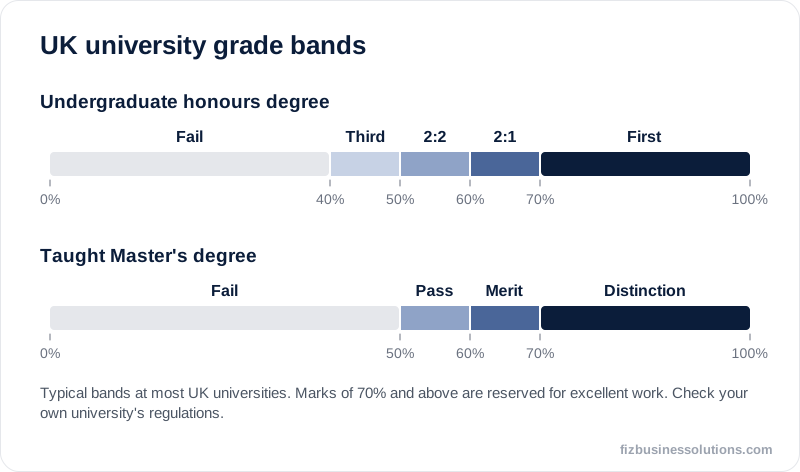
First Class Honours (a First): typically 70% and above
The highest classification. It signals work that is consistently excellent, with strong critical analysis, wide and well-used reading and a high level of independence.
Upper Second Class Honours (a 2:1): typically 60 to 69%
Often described as a 'two-one'. It shows very good, competent work with clear analysis. Many graduate employers and postgraduate programmes list a 2:1 as their usual minimum requirement, although requirements vary.
Lower Second Class Honours (a 2:2): typically 50 to 59%
Often called a 'two-two'. It indicates sound work that meets the learning outcomes but tends to be more descriptive, with less depth of argument or evaluation.
Third Class Honours (a Third): typically 40 to 49%
A pass at honours level. The work meets the minimum standard but has noticeable weaknesses in understanding, structure or use of evidence. Below 40% is usually a fail at undergraduate level, although some universities award an ordinary or unclassified degree in certain circumstances.
Tip: Many universities use borderline rules. For example, if your average is just below a boundary (such as 59.5% or 68.5%), the exam board may look at how many of your credits fall in the higher band. Your handbook will explain whether and how this applies.
UK Master's degree grading system: distinction, merit and pass
Taught Master's degrees (such as an MSc, MA or MBA) are not classified as Firsts or 2:1s. Instead, most UK universities award a distinction, merit or pass. The bands commonly used are:
- Distinction: commonly 70% and above overall, often with a dissertation mark of 70% or more required as well.
- Merit: commonly 60 to 69% overall, sometimes with a minimum dissertation mark.
- Pass: commonly 50 to 59%. At postgraduate level, the pass mark for modules is usually 50% rather than 40%.
- Fail: below the pass mark, although many universities allow resits or compensation for a limited number of credits.
How your overall Master's grade is calculated
A taught Master's degree in the UK is usually worth 180 credits: around 120 credits of taught modules and a dissertation or final project worth around 60 credits. Your overall mark is normally a credit-weighted average, so the dissertation alone can count for about a third of the final result.
Some universities add extra rules. For example, a distinction may be awarded only if a set number of credits, often including the dissertation, are at 70% or above, or a borderline average such as 68% may be raised if most of your credits are in the higher band.
Why the dissertation often decides your grade
Because of its weight, the dissertation is often the deciding factor between a merit and a distinction. Many programmes also set a minimum dissertation mark for each grade, so strong marks in your taught modules may not be enough on their own. Plan your dissertation early, agree your research approach with your supervisor and use their feedback on each chapter.
Resits, compensation and exit awards
- Compensation: some universities let you pass overall with a narrowly failed module, often a mark of 40 to 49%, if your other marks are strong enough.
- Resits: the mark for a resit module is often capped at the pass mark, usually 50%, which can affect your chance of a merit or distinction.
- Exit awards: if you complete the taught modules but not the dissertation, you may receive a Postgraduate Diploma (usually 120 credits) or a Postgraduate Certificate (usually 60 credits) instead of the Master's.
How Master's grades appear on your certificate
Your award is usually written as, for example, 'MSc Management with Distinction' or 'MA Education with Merit'. A pass is shown simply as the degree title, such as 'MBA'. Your transcript lists the individual module marks.
Master's grades and PhD applications
Many UK PhD programmes ask for a Master's with merit, and some also set a minimum dissertation mark. A distinction strengthens a scholarship application, but supervisors also look closely at your research proposal and research experience, so check the entry requirements of each programme.
Tip: The higher pass mark at Master's level catches many students out. A mark of 45% that would pass an undergraduate module may be a fail on a postgraduate one, so check the regulations for your programme.
What markers look for in each grade band
Every UK assignment should be marked against published criteria, often called a marking rubric or grade descriptors. The wording differs between universities, but the general pattern is similar. Here is a simplified summary of what typically separates the bands.
70% and above (First / Distinction)
- A clear, original argument sustained from introduction to conclusion.
- Critical evaluation of theories and evidence, not just description.
- Wide reading beyond the module list, including recent journal articles.
- Excellent structure, precise academic writing and accurate referencing.
- Insight into limitations, counter-arguments and implications.
60 to 69% (2:1 / Merit)
- A clear argument with good analysis, though not always fully developed.
- Good use of relevant literature, mostly applied rather than summarised.
- Logical structure and generally accurate referencing.
- Some critical evaluation, but less depth or originality than a First.
50 to 59% (2:2 / Pass at Master's)
- Sound understanding of the topic and the main theories.
- Writing that leans towards description rather than analysis.
- Limited reading, often relying on lecture slides and a few textbooks.
- Some weaknesses in structure, clarity or referencing.
40 to 49% (Third)
- Basic understanding with gaps or inaccuracies.
- Weak or unclear argument and limited use of evidence.
- Problems with structure, answering the question or referencing.
Why UK marks seem low to international students
Students who have studied in the USA, the Middle East, South Asia and many other regions are often used to percentage scores in the 80s and 90s. In the UK, a percentage is not a measure of how many answers were correct. In essay-based subjects it reflects how far the work meets the descriptors for excellence. That is why 65% can represent very good work and 75% can be an outstanding result.
This difference matters when you compare results with friends at home, apply for jobs abroad or report results to a sponsor. Readers unfamiliar with the system may misread your results, so it helps to be able to explain them clearly.
UK grades for Saudi and other international students
Saudi students in the UK, including those on government or employer sponsorship, are often asked how their UK results compare with a GPA. There is no single official conversion between UK percentages or classifications and a GPA scale, and different institutions, employers and sponsoring bodies use different approaches.
For that reason, avoid relying on conversion tables found online. If you need a GPA equivalent for a sponsor, a Saudi university or an employer, ask your UK university's international office or registry whether they provide an official statement, and confirm with your sponsor or the receiving organisation which method they accept.
- 1Download your official transcript and the classification rules from your university.
- 2Ask your university's international or student records team whether they issue an explanatory letter about UK grading.
- 3Contact your sponsor or the receiving institution to ask which conversion method, if any, they use.
- 4Keep copies of all correspondence in case you need them later for a job or further study application.
Tip: If your target is a PhD or a scholarship, check the entry requirements in UK terms (for example 'a 2:1 or equivalent' and 'a Master's with merit') and ask the admissions team directly how they assess your previous qualifications.
How your final degree classification is calculated
There is no single UK formula. However, many universities follow a similar pattern, so it helps to know the common features before you plan your effort across your degree.
- First year often counts as a qualifying year only: you must pass, but the marks may not affect your classification.
- Second and final year are commonly weighted, with final year usually counting more (for example a larger share for final year than second year).
- Some universities discount your lowest module marks or use the better of two calculation methods.
- The dissertation or final project often carries a large number of credits, so it can move your average significantly.
Tip: Find the 'degree classification' or 'award' section of your academic regulations and work out what your current marks mean. Knowing exactly how many credits remain, and their weighting, makes it much easier to set a realistic target.
How to move from a 2:2 to a 2:1
The gap between a 2:2 and a 2:1 is usually not about working longer hours. It is about shifting your writing from description to analysis, and making it easy for the marker to see that you meet the higher criteria. These steps help many students make that move.
- 1Read the marking criteria before you start. Highlight the words used in the 60 to 69% band, such as 'critical', 'evaluates' and 'well-supported', and plan how each part of your work will show them.
- 2Answer the exact question. Many 2:2 essays are good summaries of the topic but do not directly address the question. Restate the question in your introduction and refer back to it in each section.
- 3Build an argument. Write a one-sentence thesis and make every paragraph support, test or qualify it.
- 4Use the PEEL structure for paragraphs: Point, Evidence, Explanation, Link. The explanation stage is where analysis happens.
- 5Read beyond the slides. Add peer-reviewed journal articles, especially recent ones, and compare authors who disagree.
- 6Evaluate, do not just describe. After presenting a theory, ask how strong the evidence is, where it applies and where it falls short.
- 7Reference accurately in your required style (for example Harvard or APA). Careless referencing can cost marks in the presentation criteria.
- 8Use your feedback. List the recurring comments from your last three assignments and fix them deliberately in the next one.
Tip: Example of moving up a band. Descriptive (2:2 style): 'Maslow (1943) proposed a hierarchy of needs with five levels.' Analytical (2:1 style): 'Although Maslow's hierarchy remains widely taught, its assumption of a fixed order of needs has been questioned, which limits its usefulness for explaining motivation in diverse workplaces.'
Common mistakes that keep marks in a lower band
- Summarising the literature source by source instead of grouping ideas by theme.
- Long quotations with little comment of your own.
- Ignoring the word count, either well under or well over the limit.
- Conclusions that introduce new material or simply repeat the introduction.
- Weak proofreading, with typos and unclear sentences that hide good ideas.
- Inconsistent or incomplete referencing.
- Leaving the dissertation until late, even though it carries heavy credit weighting.
Need help with your UK university grades?
If you are aiming to move up a grade band, FIZBS (FIZ Business Solutions) has supported students since 2015, with experts holding Master's and PhD qualifications across business, management, MBA, finance and many other subjects. Our team can give expert guidance on structure, critical analysis, referencing and proofreading, and help you understand your feedback and marking criteria.
You can message us on WhatsApp at any time, 24/7, and book a WhatsApp call with an expert before ordering. Guidance and feedback on assignments start from £20 per 1,000 words, proofreading from £12 per 1,000 words, and you get 10% off your first order. Everything is 100% confidential.