Quick answer
PESTLE analyses the external environment (political, economic, social, technological, legal and environmental factors), while SWOT combines internal strengths and weaknesses with external opportunities and threats. In assignments, use PESTLE findings to inform the opportunities and threats in your SWOT, then turn the SWOT into strategy with a TOWS matrix.
SWOT and PESTLE analysis appear in almost every business, management and MBA module. They look simple, which is exactly why so many students lose marks on them. A list of bullet points under four or six headings is description, and markers are looking for analysis: evidence, prioritisation and clear links to strategy.
This guide explains how to write a SWOT analysis for an assignment and how to carry out a PESTLE analysis, how the two frameworks connect, and how to turn them into strategic options using a TOWS matrix. You will find a worked SWOT analysis example for a fictional mid-sized UK coffee chain, a short note on Porter's Five Forces, and the mistakes that most often hold students back.
What is a SWOT analysis?
SWOT stands for Strengths, Weaknesses, Opportunities and Threats. It summarises an organisation's strategic position by combining an internal view with an external one.
- Strengths (internal): resources and capabilities that give the organisation an advantage, such as a strong brand, loyal customers, skilled staff, efficient processes or financial strength.
- Weaknesses (internal): limitations that put it at a disadvantage, such as high costs, outdated systems, a narrow product range or dependence on one supplier.
- Opportunities (external): trends or changes in the environment the organisation could exploit, such as new markets, changing customer preferences or new technology.
- Threats (external): external factors that could harm performance, such as new competitors, regulation, economic downturn or rising input costs.
Tip: The quickest test: could the organisation control it? If yes, it is internal (strength or weakness). If no, it is external (opportunity or threat). "Rising energy prices" is a threat, not a weakness; "poor energy efficiency in our stores" is a weakness.
What is a PESTLE analysis?
PESTLE analysis is a tool for scanning the external macro-environment, the broad forces that affect every organisation in a market. You may also see PEST, PESTEL or STEEPLE; the idea is the same, so use the version your module uses.
- Political: government policy, political stability, trade policy, taxation decisions, public spending.
- Economic: inflation, interest rates, exchange rates, consumer spending, unemployment, wage levels.
- Social: demographics, lifestyle trends, attitudes, health awareness, working patterns.
- Technological: digital channels, automation, data and AI, payment technology, innovation in the sector.
- Legal: employment law, consumer protection, health and safety, data protection, competition law.
- Environmental: climate change, sustainability expectations, waste and packaging rules, resource scarcity.
Tip: Political and Legal often overlap. A useful distinction is that Political covers government priorities and direction, while Legal covers laws and regulations that already apply or have been passed.
How SWOT and PESTLE link together
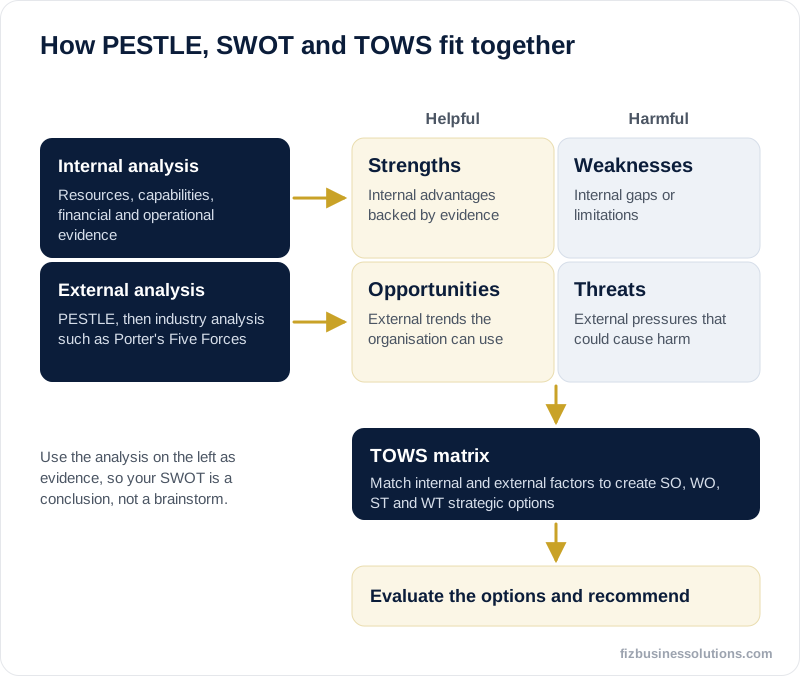
Students often present SWOT and PESTLE as two unrelated lists. In a good assignment they work as a sequence. PESTLE (and Porter's Five Forces, if you use it) analyses the external environment, and the most significant findings feed into the Opportunities and Threats of your SWOT. Your internal analysis, using evidence such as financial performance, resources, capabilities or a value chain analysis, feeds into Strengths and Weaknesses.
This makes your SWOT a conclusion drawn from analysis rather than a brainstorm. It also gives you a natural structure for the assignment:
- 1External analysis: PESTLE, then industry analysis (for example, Porter's Five Forces).
- 2Internal analysis: resources, capabilities, financial and operational evidence.
- 3SWOT: a summary of the most important points from steps 1 and 2.
- 4TOWS matrix: strategic options generated by matching internal and external factors.
- 5Evaluation and recommendations: which option(s) to pursue and why.
Where Porter's Five Forces fits in
Porter's Five Forces analyses the competitive structure of an industry: the threat of new entrants, the bargaining power of suppliers, the bargaining power of buyers, the threat of substitutes, and rivalry among existing competitors. Michael Porter introduced the model in the Harvard Business Review in 1979 and developed it in his book Competitive Strategy (1980).
PESTLE looks at the broad macro-environment, while Five Forces looks at the industry the organisation competes in. Using both before your SWOT gives a fuller external picture. In the coffee chain example below, Five Forces would highlight high rivalry, low switching costs for buyers and strong substitutes such as home coffee machines and supermarket coffee, all of which strengthen the threats in the SWOT.
How to write a SWOT analysis for an assignment: step by step
- 1Define the scope. Be clear about the organisation, the market and the time frame. A SWOT for a whole company differs from one for a single product or a planned expansion.
- 2Gather evidence. Use annual reports, company websites, industry reports, government statistics, news articles and academic sources. Every important point should be supported.
- 3Draft each quadrant, then cut. List everything, then keep only the factors that genuinely matter to the organisation's strategy. Three to five per quadrant is usually enough.
- 4Make points specific. "Good brand" is vague. "Strong local brand recognition in its home region, supported by a growing loyalty app user base" is analytical.
- 5Prioritise. Rank factors by impact and likelihood, or explain which matter most and why.
- 6Explain the "so what". For each key factor, explain what it means for the organisation's future performance or strategic choices.
- 7Move to strategy. Use a TOWS matrix or a clear recommendations section so the SWOT leads somewhere.
Tip: Present the SWOT as a 2 x 2 table for quick reading, then discuss the most important points in paragraphs underneath. The table alone rarely earns many marks; the discussion does.
PESTLE analysis example: a mid-sized UK coffee chain
The following example uses a fictional business, "Bean Street Coffee", a mid-sized coffee chain with around 40 stores in the North of England. All details are invented for illustration. In a real assignment, each point would be supported by a cited, up-to-date source.
- Political: government decisions on business rates and taxation affect the cost of operating high street premises. Trade arrangements may influence the cost and reliability of imported coffee beans and equipment.
- Economic: periods of high inflation squeeze household budgets, which can reduce spending on discretionary treats like takeaway coffee. Increases in the National Living Wage raise staff costs for a labour-intensive business.
- Social: more people working in a hybrid pattern may reduce weekday footfall in city centres but increase demand in suburban and residential areas. Growing interest in plant-based diets increases demand for dairy alternatives.
- Technological: mobile ordering, loyalty apps and delivery platforms change how customers buy. Data from apps allows personalised offers.
- Legal: food labelling and allergen rules require accurate information on products. Employment law affects scheduling, contracts and pay.
- Environmental: customers and regulators increasingly expect action on single-use cups and packaging waste. Climate change can affect coffee-growing regions and therefore supply and prices.
Tip: Do not stop at the list. Finish your PESTLE with two or three sentences identifying which factors are most significant for this business and why. These become your key Opportunities and Threats.
SWOT analysis example: Bean Street Coffee
Continuing the fictional example, here is how the SWOT might look once the PESTLE findings and an internal analysis are combined.
Strengths
- Strong regional brand identity and loyal local customer base.
- Responsibly sourced beans with a clear sustainability story.
- Well-located suburban stores, less dependent on city-centre office workers.
Weaknesses
- Limited digital presence: no mobile ordering app.
- Higher cost base than large national chains, with less buying power.
- Narrow food offering compared with competitors.
Opportunities
- Growing demand for plant-based and healthier menu options.
- Shift towards hybrid working, increasing demand in residential areas.
- Mobile ordering and loyalty apps to increase visit frequency.
Threats
- Pressure on consumer spending during periods of high inflation.
- Rising staff and energy costs.
- Intense competition from national chains, independents and supermarket coffee machines.
- Stricter expectations and possible regulation on single-use packaging.
Turning SWOT into strategy: the TOWS matrix
The TOWS matrix, associated with Heinz Weihrich (1982), takes your SWOT a step further by matching internal factors with external ones to generate strategic options. This is where many assignments move from a pass to a higher grade, because it shows you can use the analysis rather than just produce it.
- SO strategies (use strengths to exploit opportunities): use the strong sustainability brand to launch a premium plant-based range in suburban stores.
- WO strategies (overcome weaknesses by taking opportunities): develop a mobile ordering and loyalty app to compete with national chains and increase repeat visits.
- ST strategies (use strengths to reduce threats): build on community loyalty with a value-focused loyalty scheme to protect sales when budgets are tight.
- WT strategies (minimise weaknesses and avoid threats): join a purchasing group or renegotiate supplier contracts to reduce the cost gap with larger rivals.
Tip: After the TOWS matrix, evaluate the options. A simple way is to judge each against suitability, acceptability and feasibility, a framework widely used in strategy textbooks, then recommend one or two with a clear justification.
Going beyond lists: how to make your analysis critical
Markers in many UK universities reward analysis and evaluation far more than description. To show critical thinking in a SWOT and PESTLE assignment:
- Support claims with evidence and citations, not assumptions. Use recent, credible sources.
- Prioritise factors and justify why some matter more than others for this specific organisation.
- Show interconnections. For example, an economic squeeze (PESTLE) increases the threat from cheaper rivals and makes the cost weakness more serious.
- Recognise that one factor can be both an opportunity and a threat. Hybrid working may hurt city-centre stores but help suburban ones.
- Acknowledge the limitations of the frameworks: SWOT can be subjective and static, and PESTLE can become a long list with no ranking. Mention how you addressed this, for example through evidence and prioritisation.
- Use academic sources on strategy. Textbooks such as Johnson, Whittington and colleagues' Exploring Strategy are commonly recommended on UK business modules; check your reading list.
Common mistakes in SWOT and PESTLE assignments
- Putting external factors under Strengths or Weaknesses, or internal factors under Opportunities and Threats.
- Generic points that could apply to any company, such as "good customer service" or "economic uncertainty", with no evidence.
- Long lists with no prioritisation or explanation of significance.
- No sources, or outdated sources, especially for economic and political factors that change quickly.
- Inventing facts or figures about a real company. If information is not available, say so and use what can be evidenced.
- Stopping at the SWOT with no strategic options or recommendations.
- Using the frameworks in isolation instead of showing how PESTLE and Five Forces feed into the SWOT and then into strategy.
Need help with your SWOT or PESTLE assignment?
If you are unsure how to structure your strategic analysis, find credible evidence or turn your SWOT into well-justified recommendations, FIZ Business Solutions (FIZBS) can help. Business, management and MBA subjects are our strongest areas, and our experts hold Master's and PhD qualifications.
Message us on WhatsApp 24/7 or book a WhatsApp call with an expert before ordering. Assignment support starts from £20 per 1,000 words, with 10% off your first order, and everything is 100% confidential.
Reference your sources in seconds
Paste a DOI, ISBN or web link into our free Harvard referencing generator and get the full reference and in-text citation, ready to copy into your work. Using APA 7? Try the free APA referencing generator.