Quick answer
The difference between primary and secondary research is who collected the data. Primary research means collecting new data yourself, for example through surveys, interviews or experiments. Secondary research uses data or studies that already exist, such as journal articles, government statistics or company reports. Primary data fits your question exactly but takes longer; secondary data is quicker and often larger but was collected for another purpose. Many dissertations combine both.
One of the first practical decisions in a dissertation is whether you will collect your own data, use data that already exists, or combine the two. That is the difference between primary and secondary research, and it affects your timeline, your methodology chapter and the kind of approval you need.
Primary research gives you data designed exactly for your question, but it takes time and depends on people agreeing to take part. Secondary research can give you larger and higher-quality datasets quickly, but they were collected for someone else's purpose. Neither is automatically better.
This guide explains both, compares them, gives examples from different subjects, lists reliable sources of secondary data and shows you how to decide.
What is the difference between primary and secondary research?
The difference between primary and secondary research is who collected the data and why. In primary research, you collect new data yourself for your own research question, for example through a survey, interviews or an experiment. In secondary research, you use data or studies that someone else has already collected, such as journal articles, government statistics or company reports.
Primary data fits your question exactly but takes more time and usually needs research approval. Secondary data is quicker to access and often covers larger samples, but it was collected for a different purpose. Here are the key differences side by side:
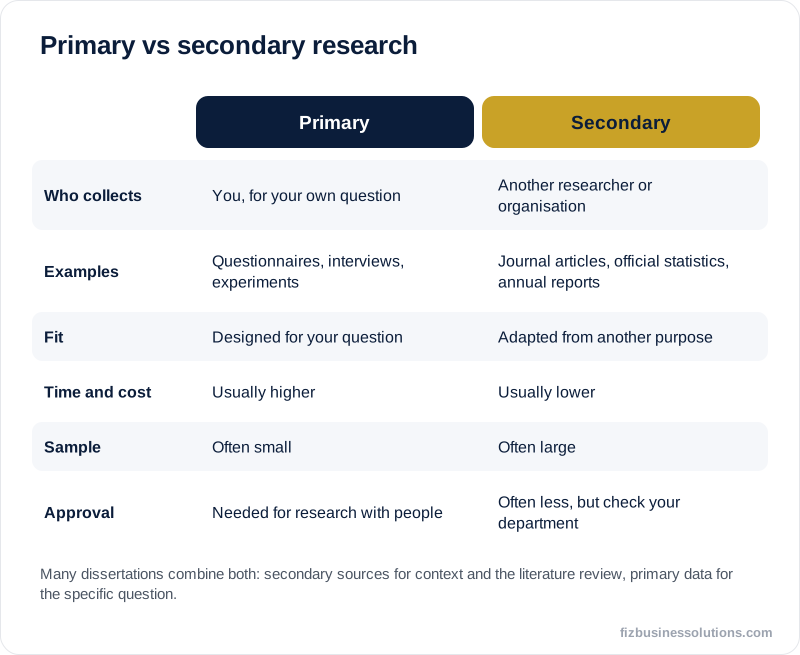
- Who collects the data: you, or another researcher or organisation
- Fit to your question: designed for it, or adapted from another purpose
- Time and cost: usually higher for primary, usually lower for secondary
- Control over quality: full control in primary research, none over how secondary data was collected
- Sample size: often small in student primary research, often large in secondary datasets
- Approval: research with people needs university approval (in the US, from your Institutional Review Board, or IRB); analysing public, anonymised data usually needs less, but check your department
What is primary research?
Primary research means collecting new data yourself, for your own research question. You design the instrument, choose the participants and control how the data is gathered.
- Methods: questionnaires, interviews, focus groups, experiments and observation
- Strengths: the data fits your question exactly, it is current, and you control its quality
- Challenges: it takes time, recruiting enough participants can be hard, and you need research approval and informed consent
What is secondary research?
Secondary research uses information that someone else has already collected. The term is used in two ways. It can mean reviewing published studies and reports, which every dissertation does in its literature review. It can also mean analysing an existing dataset, such as official statistics or company financial data, to answer a new question.
- Sources: journal articles, official statistics, company annual reports, industry reports and existing survey datasets
- Strengths: quick to access, often large samples, sometimes covering many years or countries
- Challenges: the data was collected for another purpose, variables may not match your question exactly, and you cannot fix gaps in it
Advantages and disadvantages of primary and secondary research
Advantages of primary research
- Data is designed to answer your exact research question
- You control how, when and from whom the data is collected
- Findings are current and can explore new or local topics
- Shows markers that you can design and carry out research yourself
Disadvantages of primary research
- Takes time to design, recruit participants and collect data
- Samples in student projects are often small or convenience-based
- Needs research approval and informed consent before you start
- Response rates can be low, especially for online surveys
Advantages of secondary research
- Quick and usually free to access through your library or official websites
- Large, high-quality datasets that a student could never collect alone
- Allows comparisons over many years or between countries
- Usually needs little or no approval for public, anonymised data
Disadvantages of secondary research
- The data was collected for another purpose and may not fit your question
- You cannot control how the data was collected or fix gaps in it
- Some data may be out of date by the time you use it
- Access to some databases depends on your university subscriptions
Examples by subject
Business and management
- Primary: a questionnaire to employees about hybrid working and engagement
- Secondary: analysing ten years of annual reports to compare ESG disclosure across companies
Finance and economics
- Primary: interviews with small business owners about access to finance
- Secondary: regression analysis of stock returns or national economic data
Health and nursing
- Primary: interviews with nurses about handover practice on a ward
- Secondary: a structured literature review of studies on hourly rounding and falls
Education
- Primary: a survey of teachers about using AI tools in lesson planning
- Secondary: analysis of published school performance data
Can a dissertation use only secondary research?
Yes, in many subjects. Finance and economics dissertations often analyse existing datasets, and many nursing and health dissertations are structured literature reviews. Some departments, however, expect primary data, especially in business and education. Check your handbook before you commit, and agree the approach with your supervisor.
Whichever route you take, your methodology chapter should justify it: explain why your chosen data is the best way to answer your research question, and what its limitations are.
Where to find good secondary data
- UK: the Office for National Statistics (ONS) and the UK Data Service
- United States: the U.S. Census Bureau, the Bureau of Labor Statistics, data.gov and the Pew Research Center
- Saudi Arabia: the General Authority for Statistics (GASTAT)
- International: World Bank Open Data, OECD Data and Eurostat
- Companies: annual reports and sustainability reports published on company websites
- Academic research: Google Scholar and your library databases, such as Scopus, Business Source Complete or CINAHL
- Financial data: databases your university subscribes to, which your library can list for you
How to evaluate secondary sources
- Authority: who produced it, and are they credible in this area?
- Method: how was the data collected, from whom and when?
- Recency: is it recent enough for your question?
- Purpose: was it produced to inform, to sell or to persuade?
- Fit: do the variables and population match what you need to study?
How to choose between primary and secondary research
- 1Start from your research question and list the data you would need to answer it.
- 2Check whether that data already exists in a reliable, accessible form.
- 3If it does not, consider whether you can realistically collect it yourself in the time available.
- 4Check your department rules on primary data and research approval.
- 5Agree the approach with your supervisor before you start collecting or downloading data.
Tip: Many strong dissertations combine both: secondary sources build the context and the literature review, and a modest amount of primary data answers the specific question.
Common mistakes
- Calling a literature-based dissertation "primary research"
- Planning a survey with no realistic way to reach enough participants
- Using a secondary dataset without explaining how and when it was collected
- Choosing secondary data whose variables do not really match the research question
- Starting primary data collection before receiving research approval
Reference your sources in seconds
Paste a DOI, ISBN or web link into our free Harvard referencing generator and get the full reference and in-text citation, ready to copy into your work. Using APA 7? Try the free APA referencing generator.